7 Musical Modes Explained: Scales, Chords, and Examples
Most advice about 7 musical modes starts with a memorization trick: play the white keys from each successive note and attach a name to the result. That approach shows the notes, but it often hides the music. The seven modes use the same seven-note pitch set as a major scale, yet each one makes a different note feel like home. That change reshapes the interval pattern, chord relationships, melodic gravity, and emotional color.
A faster listening method is to ask three questions. What note sounds like the root? Which characteristic note gives the mode its identity? Which chords keep bringing the ear back to that center? Use that method and the modes become one connected system, not seven unrelated scales. Ionian and Aeolian provide the familiar major and natural-minor reference points, while Dorian, Phrygian, Lydian, Mixolydian, and Locrian offer increasingly specialized colors.
1. Ionian Mode
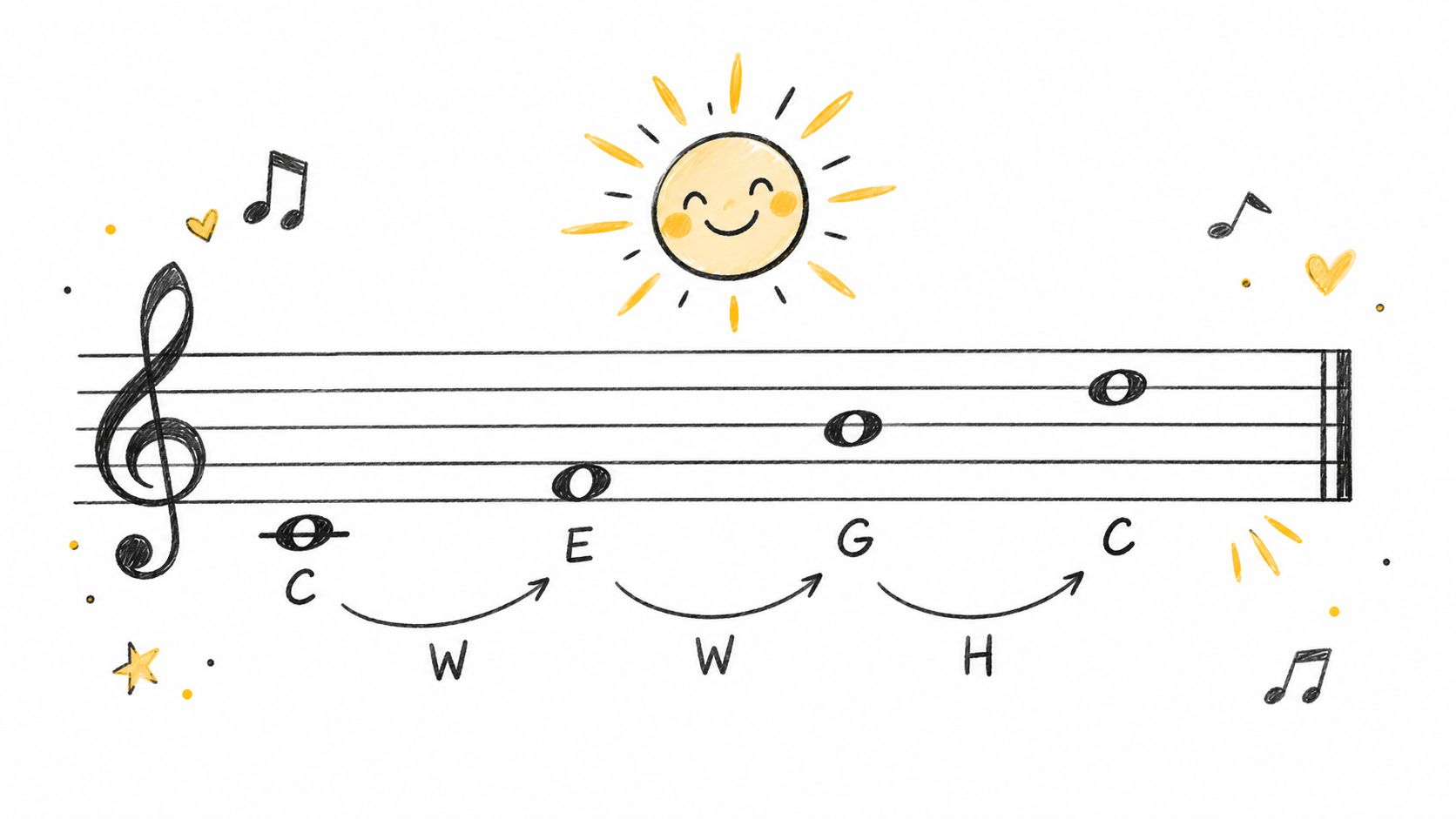
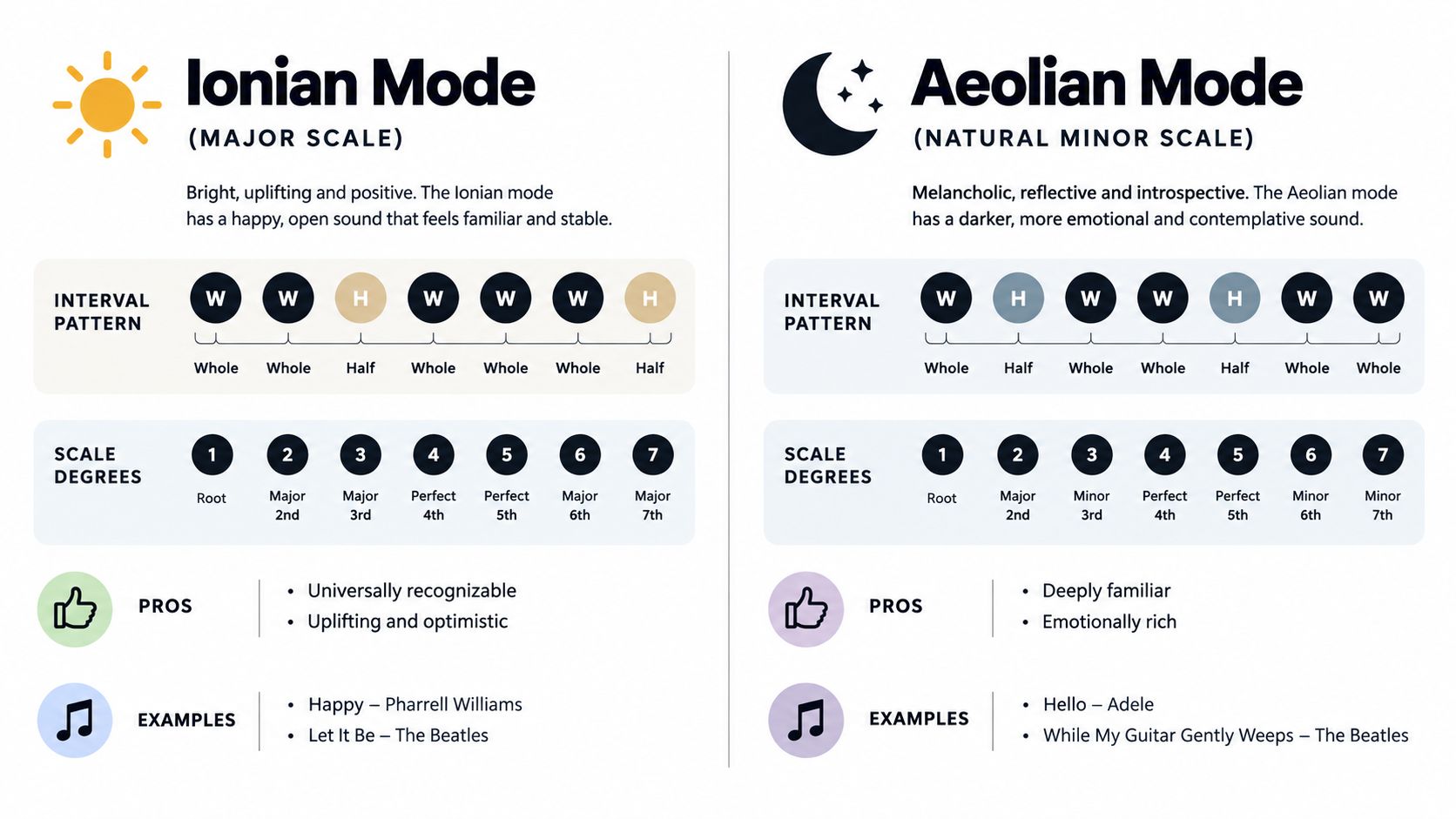
Ionian is the major scale heard from its first degree. In C, the notes are C, D, E, F, G, A, and B, with C established as the tonal center. Its interval pattern is whole, whole, half, whole, whole, whole, half, and its defining sound comes from the major third and major seventh resolving naturally around the tonic.
Because Ionian is the reference point for the other modes, start here before changing anything. Play a sustained C bass, then alternate a C major chord with melodies that return to C. The sound feels bright, stable, open, and resolved because the tonic triad, C major, clearly supports the scale.
Listening test: Hold the tonic in the bass while you play the scale. The mode becomes audible when C feels like rest, not merely when you use the notes C through B.
Popular music often uses Ionian for direct emotional clarity. Examples commonly associated with a C-major sound include Pharrell Williams's “Happy” and The Beatles' “Let It Be.” Mozart's major-key writing also shows how the mode can support both memorable melodies and formal harmonic motion.
Build a reliable baseline
Use the I, IV, and V chords, C major, F major, and G major in C Ionian, to reinforce the tonal center. A melody that lands on E highlights the major third, while a melody that approaches B and resolves to C emphasizes the major seventh's pull toward the tonic.
For production, isolate a lead vocal or non-vocal phrase and identify where the melody rests, then compare those notes with the major triad. The diatonic scale guitar guide can help connect this note-based approach to fretboard practice.
Try reharmonizing an Ionian melody with a Dorian bass line. The melody may remain familiar, but the changed chord center will make its emotional meaning less settled.
2. Dorian Mode
Dorian keeps the minor third of a minor scale but raises the sixth. In D Dorian, the notes are D, E, F, G, A, B, and C. Compared with D natural minor, the important change is B instead of B flat, giving the mode a minor foundation with a more lifted, flexible quality.
The parent major scale is C major, but D is the home note. That distinction matters. If C feels like the point of rest, you're still hearing C Ionian. Sustain D in the bass, use a D minor chord, and let the raised sixth, B, appear in the melody. The ear then hears Dorian's characteristic blend of melancholy, motion, sophistication, and hope.
Modal jazz made this sound especially clear. Miles Davis's “So What” is a familiar D Dorian reference, while Santana's “Oye Como Va” demonstrates how Dorian can support a groove without sounding conventionally major or natural minor. Funk and R&B bass lines also use the mode's major sixth to keep minor-key patterns moving forward.
Make the raised sixth obvious
Build around Dm7, with D, F, A, and C, then add B as a melodic color. A useful loop can alternate Dm7 and G7, the first two functional centers suggested by the C-major collection, while the bass continues to make D feel like home. The result is not just “C major starting on D.” It's D-centered music with a distinctive sixth degree.
Use these exercises:
- Bass focus: Sustain D or repeat a D-to-A ostinato while improvising with the Dorian notes.
- Melody focus: End short phrases on F, A, or D, then feature B before returning to A or D.
- Contrast focus: Compare the same melody over D natural minor and D Dorian. Listen for the brighter sixth rather than relying on mood labels.
Dorian works well when you want a minor color without complete resignation. It can sound reflective in a podcast bed, controlled in a film cue, or assertive in a bass-driven groove.
3. Phrygian Mode
Phrygian begins on the third degree of the major scale. E Phrygian uses the notes of C major, but E is the tonal center: E, F, G, A, B, C, and D. Its most immediate signature is the flat second, F, sitting a semitone above the root.
That close interval creates Phrygian's tense, dark, and strongly modal identity. Play an E bass, alternate E minor with F major, and return repeatedly to E. The F natural should feel like a charged neighbor to the root, not an incidental passing note. This is why Phrygian appears so often in flamenco-influenced writing, metal riffs, and dramatic world-music textures.
Flamenco guitar traditions provide a direct listening reference, especially in E Phrygian. Metallica's “Wherever I May Roam” and orchestral writing such as Gustav Holst's “Mars, the Bringer of War” are also useful starting points for hearing how a lowered second can intensify a riff or theme.
Anchor the tension with the root
Phrygian can become vague if the accompaniment doesn't establish E firmly. Use low E pedal tones, short E minor figures, or a restrained movement between Em and F. The i to flat-II relationship puts the characteristic note directly beside the tonic, making the mode recognizable quickly.
Practical rule: Don't label a passage Phrygian just because it uses the notes of a major scale from its third degree. Make the root audible, then feature the flat second against it.
For study, isolate a flamenco guitar or distorted lead and listen for phrases that approach the root from the flat second. You can also remove the accompaniment from a vocal line to hear whether the melody itself establishes E as home. A Phrygian melody over a heavy root pedal generally sounds more convincing than the same notes over a busy progression that points elsewhere.
Phrygian dominant is a related color, but it isn't the ordinary Phrygian mode. It combines a flat second with a major third and flat seventh, making it useful in flamenco fusion and other hybrid settings. Keep that distinction clear when transcribing or designing a sound.

4. Lydian Mode
Lydian is the fourth mode of the major scale. F Lydian uses C major's notes, but F is the center: F, G, A, B, C, D, and E. Compared with F Ionian, only one note changes. The fourth degree becomes raised, B instead of B flat, creating a bright intervallic lift above the tonic.
That sharp fourth is Lydian's signature. Establish F with an F major chord or bass note, then sustain or repeat B in the melody. The note creates a floating tension that doesn't sound as heavy as the flat second in Phrygian. Lydian can feel airy, luminous, magical, and slightly unreal, which explains its usefulness in film, games, electronic music, and impressionistic writing.
A simple progression is F major to G major, while F remains the tonal center. The G chord contains B, so it supports the raised fourth without forcing the ear to abandon F. Avoid treating C major as the final destination, or the passage will drift back toward the parent key.
Let the sharp fourth lead the ear
Try this short exercise:
- Play an F drone.
- Alternate F major and G major.
- Improvise with F, G, A, B, C, D, and E.
- Hold B, then resolve to A or C while returning to F.
The point isn't to play the scale quickly. It's to hear how B changes the relationship between the tonic and its surrounding harmony. John Williams's film writing, Joe Satriani's guitar-driven rock, Debussy's piano music, and many fantasy or video-game scores offer useful listening territory, although a full composition may combine Lydian passages with other tonal materials.
Use a bell, glassy synthesizer, or clear vocal tone for the raised fourth. In a dense arrangement, B can disappear into the harmony. In a sparse arrangement, it becomes the color that tells the listener the music isn't just ordinary major.
5. Mixolydian Mode
Mixolydian starts on the fifth degree of the major scale. G Mixolydian uses the notes of C major with G as home: G, A, B, C, D, E, and F. It retains the major third, B, but lowers the seventh to F. That single change gives the mode its bluesy, grounded, relaxed, and rock-oriented character.
The lowered seventh also changes the dominant behavior. In ordinary major-key harmony, the seventh often acts as a leading tone that pulls strongly toward the tonic. Mixolydian's flat seventh is less urgent, so the music can sit confidently on a dominant-seventh sound without needing conventional resolution.
Try a G7 chord, G, B, D, and F, as the main center. Add C major and F major for movement, but keep returning to G. Rock, blues, funk, and roots music frequently use this balance between a major tonic and a lowered seventh. The Rolling Stones, B.B. King's blues language, funk horn writing, and Steely Dan's complex groove-based harmony all provide useful places to listen for related colors.
Groove around the flat seventh
A practical Mixolydian exercise is to loop G7 to F, then improvise with G, A, B, C, D, E, and F. Emphasize F at the end of a phrase, then return to G. If you use F as though it were a leading tone that must resolve upward, you'll miss the mode's laid-back quality. Let it sound stable enough to belong to the groove.
For transcription, extracting a melody from a song can make it easier to study how guitar bends, vocal inflections, or horn lines treat the flat seventh. Separate the melodic layer, sing the root underneath it, and identify whether the passage establishes a major third and flat seventh around the same center.
Mixolydian also pairs naturally with funk bass patterns and dominant seventh chords. A Dorian bass line beneath a Mixolydian melody can add sophistication, but check the clash between the minor third in the bass material and the major third in the melody. That friction can be expressive when you control it deliberately.
6. Aeolian Mode
Aeolian is the sixth mode of the major scale and the familiar natural minor scale. A Aeolian uses the notes of C major from A to A: A, B, C, D, E, F, and G. Its minor third, C, establishes the basic minor quality, while the flat sixth, F, and flat seventh, G, deepen the sound.
Unlike Dorian, Aeolian has a lowered sixth. That difference is the quickest way to compare them. Play A Dorian and A Aeolian over the same A minor drone. The Dorian version uses F sharp, which can feel more open or resilient. Aeolian uses F natural, creating a more melancholic, introspective, serious, and shadowed color.
A minor-key progression might center on Am and use Dm, Em, F, and G. The tonic, subdominant, and minor dominant, Am, Dm, and Em, preserve the natural-minor collection. C major and G major can add contrast without changing the note set, provided A still sounds like the point of arrival.
Hear the lowered sixth
Use a repeating A bass and sing or play this comparison:
- A, B, C, D, E, F, G, A
- A, B, C, D, E, F sharp, G, A
The note F against F sharp supplies the clearest contrast. Adele's “Hello,” minor-key classical writing, and many rock or metal ballads show how Aeolian can carry emotional weight without the exotic tension associated with Phrygian or Locrian.
For arranging, this minor chord progression chart can help you test how natural-minor chords support a melody. Isolate the vocal from a ballad and listen for whether its strongest resting points are A, C, or E. Then preserve that melodic character while trying a new accompaniment.
Aeolian doesn't require every phrase to sound tragic. Rhythm, register, instrumentation, and harmonic pacing matter just as much as the scale. A restrained bass, a close vocal, or a sparse guitar can make the same natural-minor collection feel intimate rather than theatrical.
7. Locrian Mode
Locrian is the seventh mode of the major scale. B Locrian uses C major's notes with B as the tonal center: B, C, D, E, F, G, and A. It contains both a flat second and a diminished fifth, F against B. That diminished fifth, also called the tritone above the root, prevents the tonic from sounding as stable as the centers in the other modes.
Build B Locrian with a low B, then alternate B with the notes C and F. The B diminished triad, B, D, and F, immediately reveals the problem. It can function as a color or tension point, but it doesn't offer the same firm resting platform as a major or minor tonic chord.
Locrian therefore works especially well in short passages, riffs, transitions, horror scoring, experimental jazz, and extreme-metal textures. It can create unease, instability, and unresolved darkness, particularly when the tritone is exposed in a sparse register. Dense distortion can make the mode harder to identify, so a clean piano, low drone, or isolated synth line can be more revealing during practice.
Use instability deliberately
Try a B pedal with short phrases that highlight C and F, then move into E Phrygian or A Aeolian for contrast. The neighboring modes can provide a grounded bass environment while the Locrian melody supplies the dissonant surface. You don't need to force an entire composition to remain in Locrian for the sound to matter.
The diminished fifth is the event. Treat it as a deliberate dramatic interval, not an accidental note inside a scale exercise.
A useful production exercise is to isolate a dark ambient layer, metal guitar, or orchestral effect and search for the relationship between the root and lowered fifth. Add distortion, reverb, or a narrow register only after you understand the notes cleanly. This keeps the sound-design choices from masking the harmonic source of the tension.
The seven modes are rotations of the same parent collection, but Locrian shows why rotation alone isn't enough. A scale becomes a mode through tonal center, interval emphasis, and harmonic support.
You can also use this video as an additional visual and listening reference.
7 Musical Modes, Quick Comparison
| Mode | Complexity 🔄 | Resources/Skill ⚡ | Expected outcomes 📊 | Ideal use cases 💡 | Key advantages ⭐ |
|---|---|---|---|---|---|
| Ionian Mode (Major Scale) | Low, foundational major-scale patterns | Minimal, basic theory & common chord toolkit | Bright, resolved, highly accessible to listeners | Pop, rock, ballads, music education, remix baselines | ⭐⭐⭐⭐⭐ Familiar, stable foundation; easy melodic extraction |
| Dorian Mode | Medium, minor with raised 6th; modal context required | Moderate, needs harmonic support to define center | Minor quality with gentle uplift; sophisticated and modern | Jazz, funk, R&B, fusion, contemporary remixes | ⭐⭐⭐⭐ Versatile for groove and modern modal colors |
| Phrygian Mode | High, flat 2nd demands precise harmonic handling | High, skilled musicianship and stylistic idioms helpful | Dark, exotic, and tension-rich; strongly modal | Flamenco, metal, world music, dramatic film moments | ⭐⭐⭐ Distinctive exotic character; strong dramatic impact |
| Lydian Mode | Medium, major with augmented 4th; grounding needed | Moderate, orchestration/synth timbres enhance effect | Ethereal, uplifting, slightly surreal and magical | Soundtracks, fantasy/sci‑fi, ambient, cinematic themes | ⭐⭐⭐⭐ Magical major color; excellent for cinematic textures |
| Mixolydian Mode | Low–Medium, major with flat 7th; groove-friendly | Low, common in rock/blues instrumentations | Bluesy, groove-oriented, dominant feel within a major context | Rock, blues, funk, groove-based productions, jams | ⭐⭐⭐⭐ Accessible hybrid of major brightness and blues character |
| Aeolian Mode (Natural Minor) | Low, standard natural minor structure | Minimal, widely taught; many chord progressions available | Melancholic, introspective, deeply familiar emotionally | Ballads, pop minor keys, film/drama, emotional scoring | ⭐⭐⭐⭐⭐ Universal minor foundation; strong emotional depth |
| Locrian Mode | Very high, flat 2nd & diminished 5th create instability | High, advanced harmony and careful arrangement required | Extreme tension and dissonance; unsettling atmosphere | Horror/thriller scoring, extreme metal, experimental music | ⭐⭐ Unique tool for tension; powerful psychological impact |
Turn Mode Names Into Sounds You Can Hear
The seven modes form one connected system. Start with a major scale, choose a different degree as the tonal center, and listen for the note that changes the emotional balance. Ionian's bright identity comes from its major third and major seventh. Dorian keeps a minor third but raises the sixth. Phrygian presses a flat second against the root. Lydian lifts the fourth. Mixolydian lowers the seventh while retaining a major third. Aeolian adds the darker minor sixth to its minor framework. Locrian combines a flat second with a diminished fifth, making the center notably unstable.
Those labels only become useful when you can hear them in context. A mode isn't established by running through its notes from bottom to top. The listener needs a clear root, repeated or sustained often enough to feel like home, plus melodic and harmonic emphasis on the characteristic degree.
Use this workflow in any key:
- Choose the root: Pick one pitch and sustain it with a bass, drone, or repeated low note.
- Choose the parent collection: Use the major-scale pitch set associated with the mode.
- Feature the signature tone: Highlight the raised sixth, flat second, raised fourth, flat seventh, minor sixth, or diminished fifth.
- Support the center: Add chords that reinforce the root rather than making the parent major scale sound like the destination.
- Compare related colors: Hear Dorian beside Aeolian, Phrygian beside Aeolian, or Ionian beside Mixolydian.
Musicians can transcribe solos, remixers can compare modal melodies with new bass lines, editors can identify the emotional source of a soundtrack cue, and podcasters can choose background harmony with greater control. Isolate Audio can separate vocals, melodies, bass lines, and other described sound elements from recordings, giving you a focused way to test what your ear is hearing. Visit Isolate Audio to upload a track, isolate the part that carries the modal identity, and practice with the result.
Isolate Audio lets creators describe a target sound in plain English and receive the isolated element alongside the remainder of the recording. Use it to separate a vocal, bass line, guitar phrase, or soundtrack layer while studying the 7 musical modes, then visit Isolate Audio to start analyzing your own tracks.