Best Guitar and Amp Combo by How You Play
The usual advice is to buy the best guitar you can afford, then find an amp with enough watts. That's how you end up with a beautiful instrument plugged into an amplifier you can't turn up. The best guitar and amp combo is the pairing that sounds finished at the volume you can use, not the rig with the biggest cabinet or most impressive badge.
Treat the guitar, amplifier, speaker, and room as a system. Buy for your regular playing life, whether that means headphones after work, blues in a spare room, or rehearsals with a drummer.
Best Guitar and Amp Combos for Real Rooms
There isn't a universal winner. My default recommendation for a home player is a comfortable Strat-style guitar and a modeling combo with a convincing headphone output. Choose a traditional tube combo instead when you've tested its clean and driven sounds at your actual home volume, not just under showroom conditions.
Guitar and amp pairings by where you play
| Situation | Guitar family | Amp class | Why this pairing |
|---|---|---|---|
| Apartment practice | Strat-style single coils | Low-powered tube combo with effective volume control, or modeling amp with headphones | Clear attack without needing room-filling volume |
| Blues at home volume | Telecaster or semi-hollow | Compact tube combo with a full-sized guitar speaker and usable master volume | Responsive drive without a stack |
| Silent recording | HSS or P-90 guitar | Modeler with cabinet simulation and direct output | Repeatable takes without microphone spill |
| Rehearsal with drums | Humbucker solidbody | Medium-powered tube combo or genuinely loud solid-state combo | Strong mids and enough reserve for the band |
| First small gig | Strat-style or Les Paul-style | Gig-capable combo with clean headroom | Projection without separate head-and-cabinet logistics |
| High-gain rock | Les Paul-style humbuckers | Marshall-voiced combo, or head and cabinet when the stage allows | Sustain and focused midrange without unnecessary bulk |
Choose for your regular room
For apartment practice, prioritize headphone sound and low-volume control over tube authenticity. A small tube combo isn't automatically a quiet combo. If its volume control jumps from barely audible to intrusive, it's the wrong purchase for shared walls.
For blues at home, a Telecaster or semi-hollow into a responsive combo is a satisfying pairing, but don't confuse breakup with power-stage distortion. You can get expressive drive from the preamp or an overdrive pedal without forcing the whole amplifier into compression. That distinction keeps a good blues rig usable outside a rehearsal studio.
Silent recording changes the priorities again. An HSS guitar gives you contrasting pickup voices, while a P-90 guitar offers a direct, assertive response. Either works well into a modeler when the cabinet-emulated output sounds complete through your recording monitors.
Buy enough for the band, not an imaginary tour
At rehearsal, test your clean rhythm sound while the drummer plays normally. A distorted lead sound can seem loud alone yet disappear when bass, cymbals, and vocals enter. You need audible note definition, not merely more gain.
For a first gig, a transportable combo is usually the sensible choice. Ask whether the venue will microphone the amp, and make sure you can carry the rig yourself. A stack adds transport and connection problems before it adds anything useful to a small stage.
Buying rule: Choose for the loudest room you play regularly, then reject any candidate that can't also serve your home routine.
Don't replace a useful guitar because its pickup family differs from the table. These are starting pairings, not genre restrictions. Bring your existing instrument to the amp audition and make the complete system earn the purchase.
Match Pickups Speaker Size and Scale
Start with the guitar you own. Its pickup output and tonal balance determine how much input gain, clean reserve, and EQ adjustment you'll need. Shopping for an amplifier with an unfamiliar demonstration guitar hides those relationships.
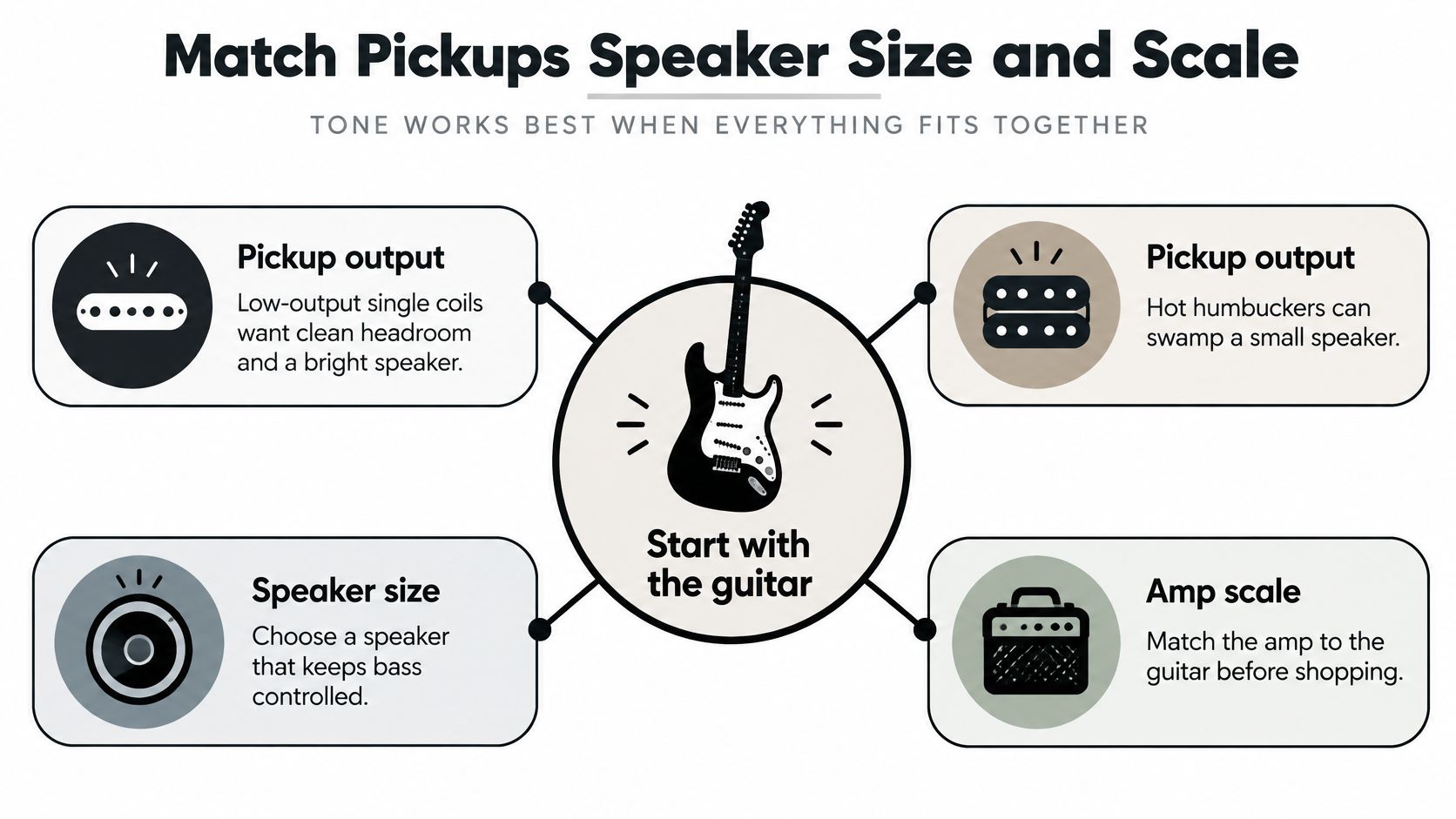
This map shows the matching variables to check before comparing brands.
Pickup output comes before the gain knob
Low-output single coils are a useful starting point for clear chords and touch-sensitive cleans. Give them enough clean reserve, but don't automatically pair them with the brightest speaker available. A bright guitar into a bright amplifier can make pick attack tiring rather than articulate.
Hot humbuckers push the input harder. If the sound becomes congested, reduce input gain and bass before deciding that the speaker is too small. Pickup output doesn't physically overload a speaker by itself; the amplifier's output and the speaker's limits determine that.
P-90s occupy useful territory between those familiar reference sounds, although individual designs differ. Test sustained notes for noise, open chords for separation, and palm-muted passages for bass control.
Speaker size and scale are clues, not verdicts
Guitar World's combo-amp guidance notes that a 15-watt tube amp can outperform a higher-wattage solid-state amp in perceived loudness, while a 12-inch speaker generally offers more projection and low end than smaller speakers. Neither observation makes the larger-sounding option the better home purchase.
A smaller speaker can be perfectly useful for practice, but listen for boxy mids with thick-sounding pickups. A larger speaker may feel fuller at the same listening level, yet cabinet design and speaker voicing still matter. Diameter alone won't tell you whether a combo controls bass well.
Scale length deserves a playing test rather than a tonal stereotype. Fender-style and Gibson-style instruments can feel different under the fingers, but strings, setup, pickups, and technique complicate any claim that scale alone produces snap or thickness. Choose the feel that lets you play cleanly, then EQ the amplifier around the actual instrument.
Use these checks before selecting an amp family:
- Pickup response: Does your strongest pickup stay defined when you strike a chord hard?
- Usable level: Can you get your preferred attack and sustain without exceeding the room's limits?
- Tone range: Do you need a focused clean-and-drive setup, or several contrasting sounds and recording options?
If your sessions regularly move between practice tracks, recording, and different styles, a modeler is usually the more practical purchase. A traditional combo makes sense when you already know the core response you want.
Strat and Les Paul as Reference Targets
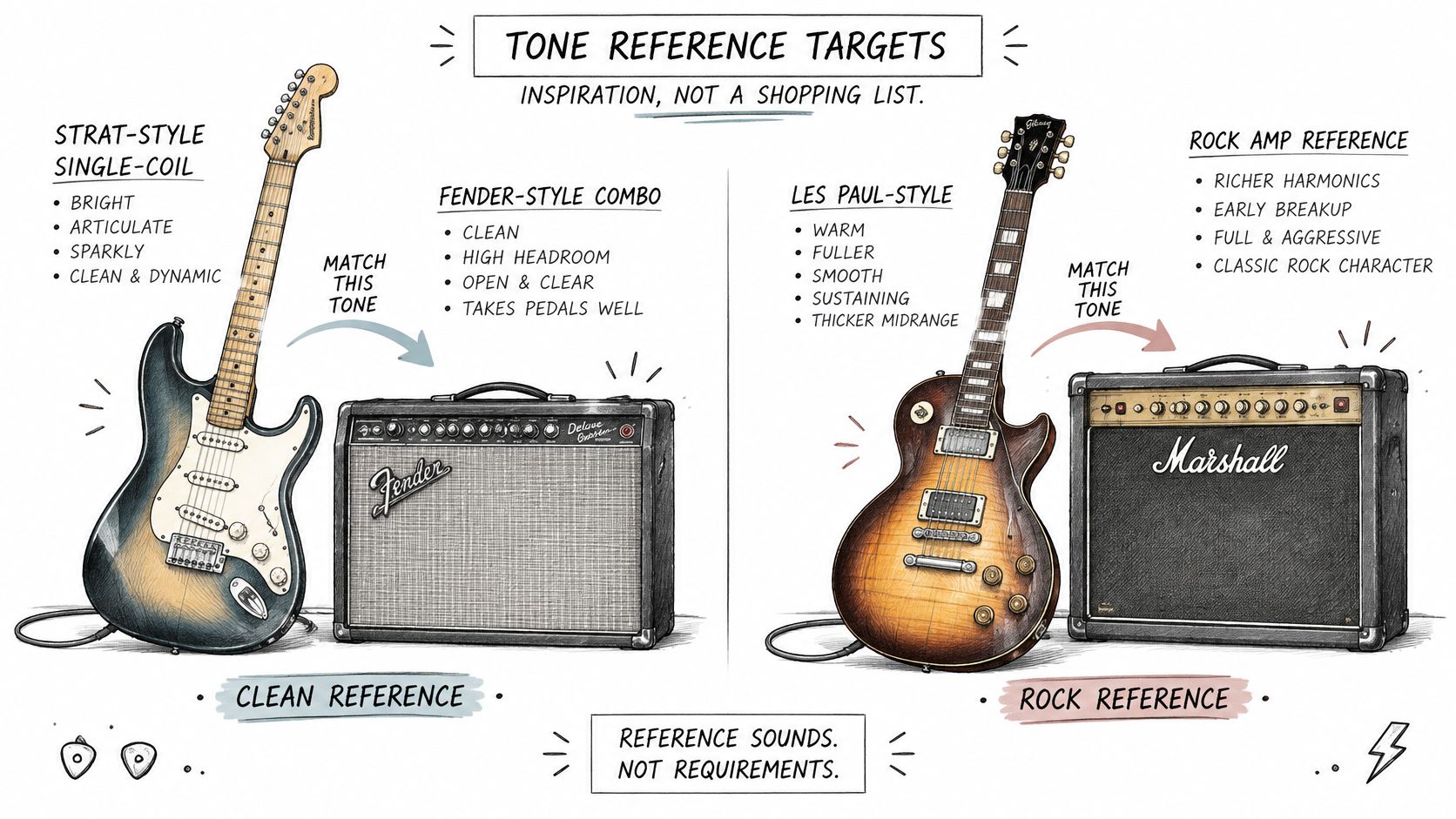
Use the classic Fender and Marshall pairings as tone targets, not mandatory shopping lists. You're choosing how the system responds to your hands, not recreating somebody else's stage inventory.
The useful contrast is clean articulation against gain-led sustain.
The Fender-style target
A Strat-style guitar into a clean Fender-family amplifier gives you a clear reference for chord separation, bright attack, and dynamic playing. Fender's history of the Stratocaster describes the instrument's place within the company's connected guitar-and-amplifier approach.
Think of the Deluxe Reverb and Twin Reverb families as reference points, not interchangeable purchases. Audition the specific amp for the clean reserve you need. For funk, country, indie, or pedal-driven blues, the important question is whether hard-struck chords remain intelligible before your drive pedal enters the signal chain.
Choose this target if pedals should supply the distortion. You don't need the clean amp to sound exciting through heavy compression; you need it to preserve the guitar's shape and respond predictably to the pedalboard.
The Marshall-style target
The Les Paul and Marshall reference points toward sustained notes, assertive mids, and amplifier-generated drive. The Gibson Les Paul history dates the original P-90-equipped model to 1952 and Marshall's first amplifiers to autumn 1962, when players wanted more gain and power than the American amplifiers available to them.
That history doesn't mean every Les Paul needs a huge cabinet. A Marshall-voiced combo or modeled British amplifier can provide the desired midrange emphasis without reproducing the original stage format. Distinguish a classic crunch voice from a modern high-gain channel before buying, because the badge alone won't settle that choice.
Use the accompanying demonstration to identify the response you prefer, then audition candidates at matched listening levels.
Play a clean chord, a muted rhythm passage, and a sustained lead line on each candidate. If you prefer the Fender-style response, protect clarity as you add drive. If you prefer the Marshall-style response, listen for note definition beneath the saturation rather than choosing whichever setting sustains longest.
Set Speaker Load and Power Handling
The speaker is a tone-shaping component, not a transparent monitor. Sound On Sound's guide to guitar speakers places useful electric-guitar bandwidth broadly around 70 Hz–6 kHz and explains how frequency response, cone breakup, sensitivity, and enclosure design affect the result.
An open-back combo can sound spacious, with less low-end reinforcement than a closed enclosure. For articulate clean playing, favor a speaker that stays controlled rather than compressing early. For blues or recording, some speaker coloration can be appealing, but don't pursue it by exceeding the speaker's power rating.
Check electrical compatibility first
Guitar.com's speaker guide describes common nominal loads of 8 or 16 ohms and recommends roughly double the amplifier's rated output for a hard-driven single-speaker setup, illustrated by a 15-watt tube amp with roughly 25–30 watts of speaker handling.
Impedance and speaker power checks
| Case | Numbers | What happens | Do this |
|---|---|---|---|
| Matched combo load | Match the labeled nominal impedance | The amp operates into its intended load | Follow the output label and manual |
| Higher than rated load | Higher speaker impedance than the intended output | Power delivery changes; results differ by amp design | Don't assume it's safe without manufacturer approval |
| Load below rating | Below the stated minimum or required match | Excess current, heat, or other damaging conditions can result | Don't connect the lower-impedance load |
| Hard-driven single speaker | Speaker handling comfortably above amp rating | Extra handling allows reserve for peaks | Choose an appropriate margin, not equal ratings by default |
| Different impedance versions | Same speaker family, different voice coil | Subtle tonal differences may exist | Choose compatibility before brightness |
Don't apply a simple resistance-to-power calculation universally. Some solid-state amplifiers deliver less power into higher impedances, but a transformer-coupled tube amplifier needs the load specified for its output connection. A higher impedance isn't a universal safe workaround.
Treat an extension cabinet as a wiring change
Adding a cabinet changes the load the amplifier sees. The internal speaker and extension cabinet may operate together, or a socket may disconnect the internal speaker. Read the manual instead of assuming identical-looking sockets behave alike.
Use a proper speaker cable between an amplifier output and a passive cabinet. An instrument cable isn't a substitute. Before replacing a speaker, confirm mounting clearance and physical dimensions as well as its electrical specifications; our guide to how to measure speakers helps with the physical fit.
Connection check: Read the amplifier's output-load label and the cabinet's impedance label before connecting them. Neither the plug shape nor the cabinet's size tells you whether they match.
Keep a required speaker or approved load connected to a tube amplifier during operation. A headphone socket or recording output doesn't automatically mean the amp can run without its speaker. Follow the manufacturer's explicit instructions for silent operation.
Keep Tone at Apartment-Safe Volume
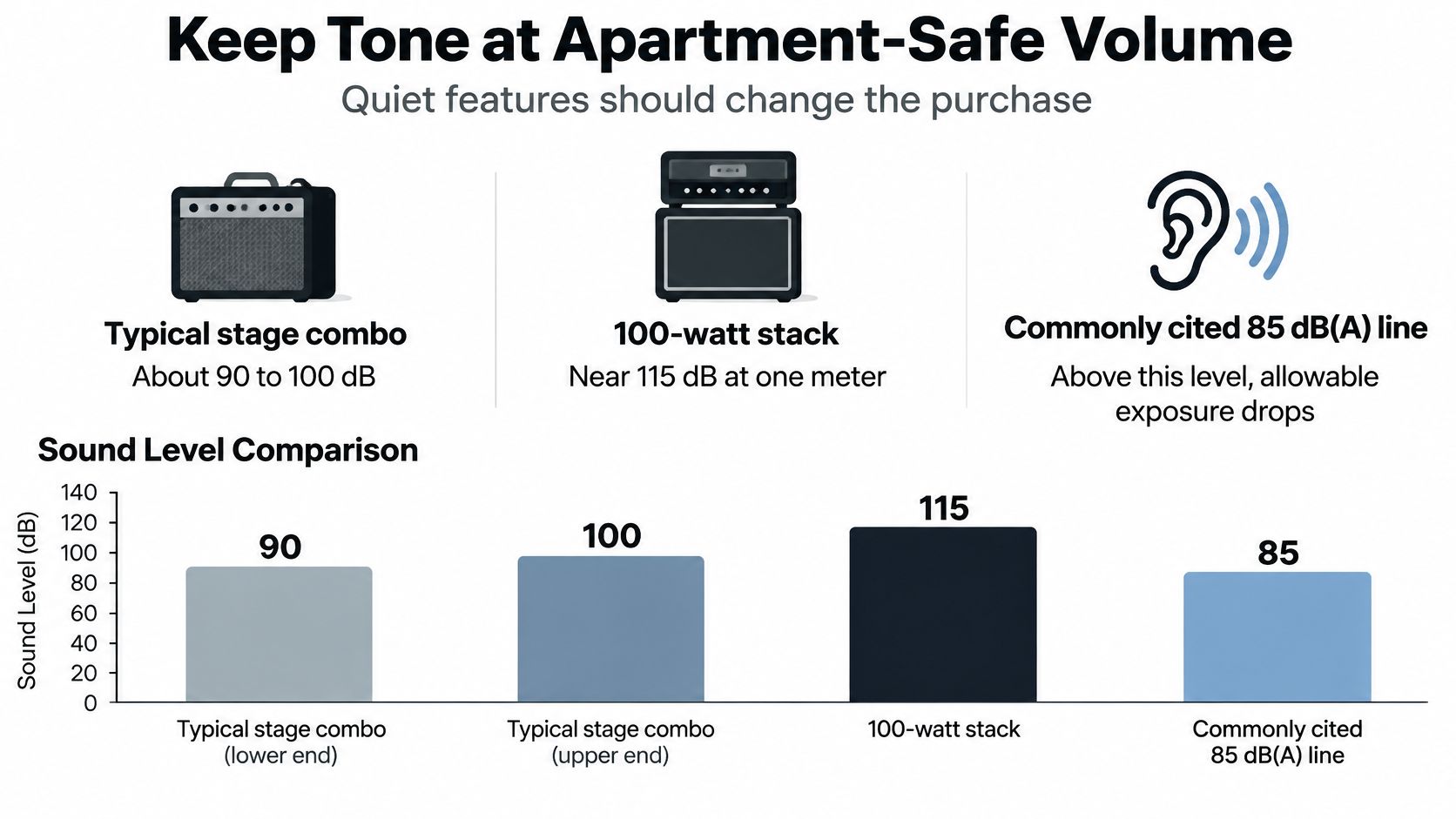
Bollsen's hearing-protection guide for guitarists places a typical stage combo around 90–100 dB and a 100-watt stack near 115 dB at one metre, above the commonly cited 85 dB(A) occupational exposure threshold. That threshold isn't a guarantee of safe listening below it or permission for unlimited exposure; duration matters.
Quiet features should therefore change the purchase, not sit at the bottom of the specification sheet. An amplifier that sounds balanced only when your ears start protesting is a poor home tool.
The comparison illustrates why stage capability and domestic suitability are different requirements.
Test the quiet functions in order
- Master-volume behavior: Start at your normal practice level. Reject a control that makes fine adjustment difficult or leaves the sound thin until it's too loud.
- Attenuation or power scaling: Compare attack, bass definition, and noise with reduced output engaged. These features must sound useful, not merely reduce the meter reading.
- Headphone output: Bring your own headphones. Listen for body, harsh treble, hiss, and whether cabinet simulation remains active.
- Recording output: Record into your interface and play along through your normal monitoring setup. Check both tonal quality and distracting delay.
An attenuator can reduce speaker volume while the amplifier works harder, but it doesn't recreate every aspect of a loud speaker moving air. Buy it for the result you can hear at home, not for a promise that every cranked-amp sensation survives unchanged.
Choose the right home tier
For shared walls or late-night playing, choose headphones and a modeler or software rig first. A small head still needs its required load, and a low power rating doesn't prove it will suit the building.
For a room where quiet amplified playing is welcome, consider a compact combo with a genuinely progressive master volume. Test it from your listening position, not with your ear beside the speaker.
For regular rehearsals and gigs, a louder combo can be justified, provided its domestic mode also works. Use suitable hearing protection with a loud band, keep exposure down, and don't turn up because the amp sounds more impressive.
If software is the more realistic option, compare our guitar VST recommendations against the headphone and recording features you'd otherwise buy in hardware. Headphones solve sound leakage, not hearing safety, so keep their level controlled too.
Where the Money Should Go First
Spend on the weakest part of the system, not evenly across the shopping list. A guitar that plays comfortably through an appropriate amp beats a prestigious instrument through an amplifier that makes every session unpleasant.
Where to spend at each budget
| Budget | Put the money here | Skip for now |
|---|---|---|
| Tight starter budget | A stable, playable guitar and an amp with a useful quiet sound | Decorative appointments and stack-shaped practice gear |
| Guitar already plays well | Better speaker response, practical volume control, or a capable modeler | Cosmetic guitar upgrades |
| Rehearsal-ready budget | Reliable band-level performance and straightforward transport | Extra cabinet bulk without a clear need |
| More money available | Fix a specific recording, reliability, or performance limitation | Replacing a complete, useful rig out of habit |
The guitar gets priority when it obstructs playing
Tuning instability, uncomfortable action, choking bends, and persistent fret problems deserve attention before pickup shopping. Have a competent technician distinguish an ordinary setup issue from damaged frets or a structural problem. Don't replace a guitar that only needs sensible adjustment.
Squier and Epiphone are useful families to audition, alongside sound used instruments. Judge the individual guitar: test the controls, listen for intermittent output, inspect the neck, and play across the fretboard. A desirable headstock doesn't excuse a poor example.
If the neck has a serious structural problem, don't assume an expensive repair is automatically the right investment. Compare the repair estimate with a replacement that already plays properly.
The amp gets priority when the guitar already works
If the instrument feels right but the amplified sound is harsh, congested, or impractical, stop spending on guitar cosmetics. The next purchase should solve the actual bottleneck: speaker response, gain control, monitoring, or recording connectivity.
A used Fender Blues Junior, Marshall combo, or established modeling amplifier can be worth auditioning. Used equipment isn't automatically better value, though. Test warm-up behavior, controls, sockets, speaker rattles, and unwanted noise, and leave room in the budget for any known service work.
Extra money stops helping when it buys features you won't use instead of removing a problem you encounter every week.
An attenuator only makes financial sense when you already like the amplifier and understand its compatibility requirements. Adding accessories to rescue the wrong amp can cost more effort than changing to a better-suited model.
Buy effects after the basic dry sound works. Our guide to must-have pedals can help you choose deliberate additions, but a drive pedal won't fix an uncomfortable guitar or an unusable volume control.
Buy the Pairing You Can Play This Week
Make the purchase decision with your guitar in hand and a realistic practice session in mind. Don't accept a spectacular demonstration as proof that the equipment will fit your room, your band, or your recording routine.
Make the decisions in a fixed order
Choose your real situation. Select the playing environment that occupies your normal week. If you mostly practice at home, don't let an occasional invitation to a loud jam determine the entire purchase.
Test your pickup response. Use your strongest pickup and your quietest useful sound. Play familiar chords and phrases rather than unfamiliar showroom licks, so you can judge articulation, noise, and feel without changing your technique.
Verify the speaker connection and domestic sound. Read the load labels before connecting cabinets, then demonstrate the exact quiet mode you'll use. Ask the seller to show any headphone, direct-output, or speaker-disconnection procedure rather than accepting a general assurance.
Set the spending limit around the missing capability. If a used name-brand combo fits the task, compare its condition against a new alternative with warranty coverage. Walk away from extra weight, channels, or cabinet size that don't solve a regular problem.
Record a useful practice take. Capture the emulated output or use a simple microphone, then listen back for timing, chord balance, and unwanted noise. When your guitar shares a recording with drums or vocals, Isolate Audio lets you describe the target sound in plain English and separate it into an isolated file and the remainder; use either output, both, or combine them.
Make the recording part of the test
A recording reveals whether the sound supports the music without the distraction of standing beside the amplifier. Listen for clear rhythm attacks and sustained notes that don't bury the following phrase. Separation can help create a practice track, but it won't turn clipped or poorly captured audio into a clean original recording.
For that practice-track workflow, our quality presets are Best for studio quality, Balanced for everyday use, and Fast for quick results. Our Free plan includes standard quality processing, MP3 output, audio files up to 5 minutes, and community support.
The best guitar and amp combo should be ready for an ordinary evening, not just a special occasion. Choose the instrument you want to pick up and the amplifier you can switch on without negotiating with the whole building.
Isolate Audio helps you turn a rehearsal recording into an isolated guitar part and a separate remainder for focused practice. Visit Isolate Audio, upload a take from your chosen rig, and describe the guitar sound you want to extract so you can practice against the part or the backing.