8 Hard Guitar Solos to Learn, Analyzed for Technique
Most hard guitar solos aren't hard only because they're fast, and listeners don't even agree on what makes one sound difficult. In a 2013 peer-reviewed study of 15 audio-visual performances and 59 participants, music students rated fast-tempo solos as more difficult and impressive than untrained listeners did, while untrained listeners leaned more on visible physical engagement, according to the Lehmann and Kopiez study in Musicae Scientiae. That's the right lens for this list.
These eight solos stress different skills. You'll get two-handed tapping, alternate picking, legato, wide bends, wah control, sustain, layered harmony, and neoclassical arpeggios. A player who's clean at speed can still fail on pitch, muting, or phrasing.
Judge each one the same way. Find the hardest passage, isolate the guitar so you can hear its timing and articulation without the band, then drill that passage until it holds together. That's what turns a famous solo into a useful study piece, whether you're transcribing by ear, preparing a cover, or picking the next technique gap to fix.
1. Eddie Van Halen - "Eruption"
“Eruption” is a short, standalone track from Van Halen's 1978 debut album. Its two-handed tapping helped establish a vocabulary that hard-rock players still study, alongside rapid picking, harmonics, and whammy-bar effects.
Watch the picking-hand tap stay relaxed in a close performance before copying the shape.
The Passage That Breaks Down
The closing two-handed tapping sequence is the main test. The fretting hand must hold its position while the tapping finger lands cleanly and pulls off. Mute the surrounding strings; one ringing open string can muddy the whole phrase.
To practice, describe the guitar sound you want isolated in plain English, such as “guitar solo.” Then loop one tapped pattern and listen for even volume between tapped and fretted notes.
- Chunk it first: Learn one tapping cell slowly before joining sections.
- Stay close: Keep fingers near the neck and avoid pressing harder as you speed up.
- Raise BPM gradually: Increase the metronome in small steps after three clean repeats.
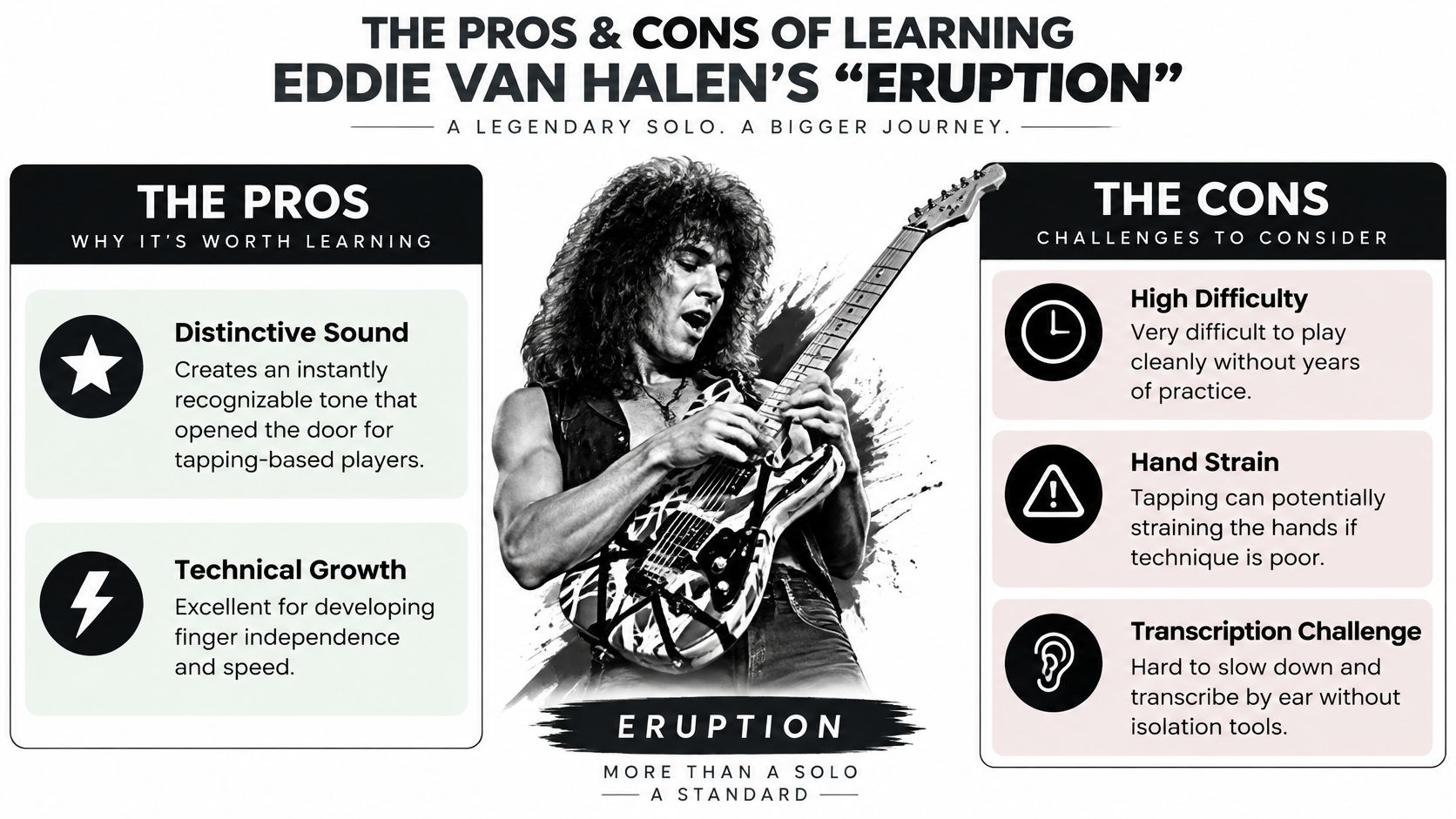
The infographic below weighs the payoff against the practice cost.
2. Randy Rhoads - "Crazy Train" Guitar Solo
Randy Rhoads makes "Crazy Train," from Ozzy Osbourne's Blizzard of Ozz in 1980, sound composed rather than improvised. Melodic phrases, classical-style lines, and fast picked runs sit tightly against the riff, which is why tribute players keep returning to it.
The hardest moment is the fast ascending run into the harmonized figure. Players often rush the string changes, then arrive late for the bend that resolves the phrase. Learn the melody at speaking pace first so you know where each run is aimed.
Practical rule: If you can't sing the phrase ending, you're not ready to speed up the run that leads into it.
Isolate the lead from vocals and drums and check two things, bend pitch and the exact point where each phrase lands on the beat. Then rebuild it with a backing track for guitar practice so you're not hiding timing errors under Rhoads's original take.
For a typical cover-band use case, practice the melodic opening at full dynamic level and the fast run separately at low volume. That split trains alternate picking across strings without teaching you to play the whole solo at one flat intensity. The phrases need to breathe, even when the picking gets dense.
3. Joe Satriani - "Surfing with the Alien"
Satriani's title track from his 1987 album Surfing with the Alien is a fluidity test. Legato runs, pitch-axis phrasing, whammy-bar scoops, and wide vibrato have to sound vocal, not mechanical. That's harder than getting the notes under your fingers.
Where It Falls Apart
The long legato passages expose uneven hammer-ons and pull-offs immediately. One weak note drops in volume, the next picked note jumps out, and the line loses its slide. Isolate the guitar and listen only for volume consistency before you worry about tone.
Work this drill for a rock lesson or recording study:
- Legato slowly: Play one run with no picking except the first note on each string.
- Vibrato separately: Loop a single held note and match Satriani's vibrato width and speed.
- Bar control last: Add whammy dips after the fretted phrase is in tune.
Record yourself and compare phrasing, not just accuracy. Check where he slides into a target note instead of landing squarely on it, and where a bend starts slightly flat for effect. If you're copying every note but missing those entries, you don't have the solo yet.
4. David Gilmour - "Comfortably Numb" Solo
Don't mistake slow for easy. The second solo in Pink Floyd's "Comfortably Numb," from The Wall in 1979, gives you nowhere to hide. Long bends, sustained notes, and deliberate gaps mean pitch and timing are exposed for seconds at a time.
The big bends near the climax are the hardest passage. You have to reach pitch, hold it without wavering, add vibrato without pulling sharp, then release cleanly. A fast player with weak bend control will struggle here more than in a shred run.
Use an isolated guitar track to check bends against the backing chord, a workflow covered in this guide to how to isolate guitar from a song. Play with a tuner visible at first, then turn it off and record to test your ear.
This sketch captures the study-piece side of the solo, one guitar carrying the whole emotional weight.
For live or tribute use, practice with delay and reverb on, because the spacious effects change how long you should hold each note. Too much gain makes the bends sound compressed and flat. I recommend learning it clean first, then adding effects once pitch is reliable.
5. Jimi Hendrix - "Voodoo Child (Slight Return)"
Hendrix turns the wah pedal into a second voice on "Voodoo Child (Slight Return)," from Electric Ladyland in 1968. The notes are blues-based. The difficulty is coordination, your foot, bends, muting, and rhythm-to-lead transitions all moving together.
Learn the wah pattern without fretting full phrases first. Rock the pedal on the beat while muting the strings, then add one bend at a time. Support ring-finger bends with your middle finger so pitch stays steady while the wah sweeps.
The wah should follow the phrase rhythm, not pump up and down at a constant rate just because your foot is on it.
Isolate the guitar to hear where Hendrix opens the wah for a vocal peak and where he closes it down for a darker, percussive chunk. That distinction is what blues and rock cover players usually miss. They copy the licks but play the pedal as decoration.
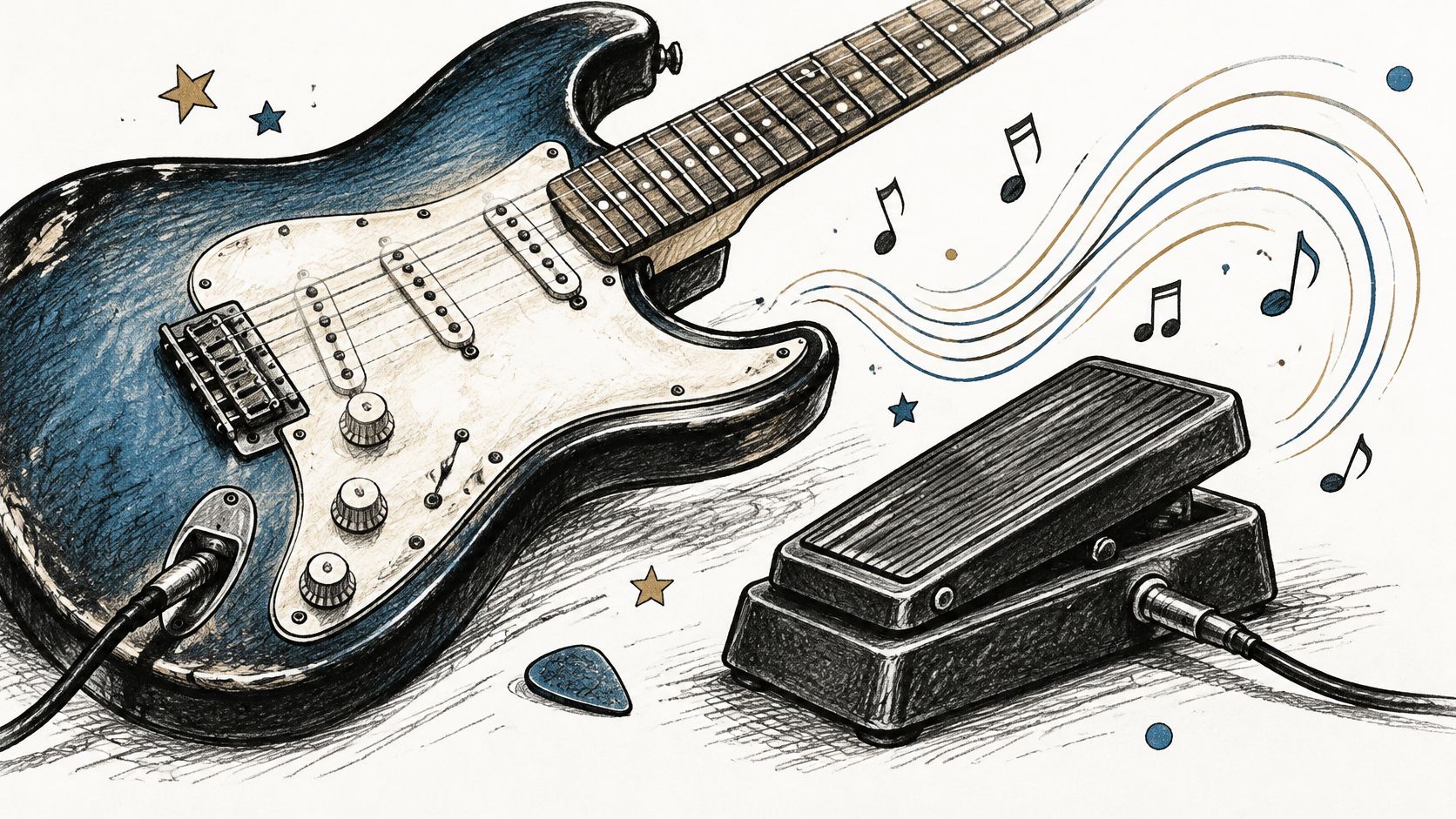
The illustration below pairs the guitar and wah for a reason, they're one instrument here.
For a jam-night use case, drill the intro phrase until the transition from muted rhythm strokes to lead bends feels automatic. If you have to look at your foot, the groove is already gone.
6. Slash - "November Rain" Guitar Solo
Slash builds the "November Rain" solos, from Guns N' Roses' Use Your Illusion I in 1991, like a singer stretching a melody over an orchestra. The first two solos reward patience. The final outro solo adds endurance, faster runs, and sustained bends at performance volume.
The Real Endurance Test
That closing section is where players fade. Vibrato gets narrow, bends fall flat, and picked runs turn tense because your forearm is tired. Break the outro into short sections and learn each ending bend before you connect the whole build.
Isolate the guitar stem and compare your phrasing against the orchestral backing. Notice where Slash leaves space for piano and strings instead of filling every gap. Copying only the dense parts teaches the wrong lesson.
- Bend with a tuner: Check the long target notes, then test them by ear.
- Section the build: Practice the final climb as separate phrases with clear stop points.
- Rehearse at volume: Play the full solo standing up to expose endurance problems early.
For a wedding-band or rock-cover player, this is a study in pacing a long feature. If you peak too early, the final minute has nowhere to go.
7. Brian May - "Bohemian Rhapsody" Guitar Solo
Brian May's solo in Queen's "Bohemian Rhapsody," from A Night at the Opera in 1975, is short, singable, and deceptively tricky to reproduce. You're not learning one line. You're learning a main melody with layered harmonies recorded on his homemade Red Special.
Start with the lead melody alone and get every bend and slide in tune. Then add one harmony at a time. If you jump straight to the layered sound, small pitch errors stack up and the whole passage sounds sour.
Isolate the guitar to hear how the layers enter and which line carries the melody at each moment. That's the key studio lesson here, and it's why this solo gets referenced in discussions of guitar layering. Multi-tracking isn't just thickness, it's arrangement.
A useful recording exercise is to track the melody once, mute it, record the harmony against the backing, then bring both back and check tuning. Use a tuner for sustained harmony notes before you commit a take.
Studio check: If a harmony only sounds right when it's buried under the lead, it isn't in tune yet.
For live players, decide which line you'll play. One clean melody beats a messy attempt to suggest every layer at once.
8. Yngwie Malmsteen - "Far Beyond the Sun"
"Far Beyond the Sun," featured on Malmsteen's Odyssey in 1988 in this list's reference recording, is the endurance and synchronization peak here. Neoclassical arpeggios, harmonic-minor scale runs, and sweep-picked figures arrive in long chains with little recovery time.
The hardest passages are the extended arpeggio sequences linked straight into scale runs. Your picking hand changes motion, your fretting hand changes shape, and any ringing string ruins the classical clarity. Speed without muting control just sounds like noise.
The artwork below suits the piece, dense notation swirling around one very busy fretboard.
Isolate the guitar and loop one arpeggio shape until each note is separate. Then study the underlying scale shapes through this diatonic scale guitar guide and adapt the same positions to harmonic minor, so you understand the sound instead of memorizing a blur.
Advanced students use this track to audit picking efficiency. Practice arpeggios slowly, keep pick movement small, and stop a run the moment tension creeps into your shoulder. Build length gradually. Playing through strain teaches sloppy synchronization you'll have to unlearn later.
Main difficulty, key technique, and practice focus for each of the eight solos
| Item | Main Difficulty | Key Technique | Best Practice Focus |
|---|---|---|---|
| Eddie Van Halen - "Eruption" | Clean, high-speed execution | Two-handed tapping and legato runs | Practice slowly in sections; increase tempo gradually |
| Randy Rhoads - "Crazy Train" Guitar Solo | Fast picking and precise timing | Alternate picking and melodic phrasing | Learn phrases first; use a metronome and preserve dynamics |
| Joe Satriani - "Surfing with the Alien" | Even legato and controlled effects | Legato, vibrato, and whammy bar | Practice slowly for even volume; develop vibrato separately |
| David Gilmour - "Comfortably Numb" Solo | In-tune bends and expressive timing | Sustained notes, bends, and vibrato | Focus on pitch control, timing, and note sustain |
| Jimi Hendrix - "Voodoo Child (Slight Return)" | Coordinating wah control with expressive playing | Wah-wah, blues bends, and rhythm-to-lead transitions | Practice wah patterns separately and shape blues phrasing |
| Slash - "November Rain" Guitar Solo | Endurance and consistent phrasing | Sustained bends, vibrato, and dynamic control | Learn in sections; build stamina and check bend pitch |
| Brian May - "Bohemian Rhapsody" Guitar Solo | Timing and matching layered harmonies | Multi-tracked harmony and melodic phrasing | Learn the melody first, then add and tune harmonies |
| Yngwie Malmsteen - "Far Beyond the Sun" | High-speed precision and endurance | Alternate picking, arpeggios, and harmonic minor runs | Build speed gradually; practice arpeggios and scales slowly |
Turn Hard Solos Into a Practice Plan You Can Follow
Pick one solo, not eight. Your next piece should match the skill you're weakest on, bends, legato, picking, tapping, wah coordination, harmony, or endurance. If you're still building basic fretboard confidence, work through Maxijournal's beginner guitar guide before you spend weeks forcing a passage your hands aren't ready for.
Start with listening, not full-speed attempts. In a controlled music-learning study, silent motor practice produced significantly better performance than first-sight playing, and even 12 minutes of daily listening or study over five days produced measurable improvement. Use that structure. Isolate the lead, mark accents and articulation, then practice muted or very slowly before adding distortion.
A Four-Bar Routine That Works
Find the hardest four bars and stay there. Set the metronome well below target tempo, play three clean repeats, then raise it in small steps. Don't judge progress by peak BPM alone.
A guitar timing case study tracked an 11-note melody played 55 times and found average duration fell from approximately 8 seconds to 6 seconds while timing variability dropped, as reported in the guitar timing and motor learning case study. Copy that logic. Record repeats, check whether note spacing gets steadier, and only add tempo when it does.
Keep sessions focused and sustainable. Work in short blocks, rotate between two passages instead of hammering one until your hands tense up, and test the passage again the next day before you warm up on it. Next-day recall tells you what you learned.
For the isolation step, you describe the sound in plain English, such as "lead guitar solo," and Isolate Audio separates that element from the rest of the recording. You get the isolated guitar to study and the remaining audio to practice against, so every bend, slide, tap, and run is easier to hear and drill.
Upload the recording you're learning, describe the part as "lead guitar solo," and use the isolated track to loop the four bars that keep tripping you up, then switch to the remaining audio as your backing track. That turns any of these hard guitar solos into a passage-by-passage practice session you can measure. Try it with your next study piece at Isolate Audio.