How to Make Rap Songs from Beat to Release
You've got a rough beat open, a few lines in your notes, and three different ideas for what the track should sound like. The hook feels like a party record, the verse is personal, and you're already wondering whether the mix will work in a short video. That's a normal place to start, but it's also where a track can drift if each decision is made separately.
Learning how to make rap songs means treating the beat, lyrics, performance, mix, and release as parts of one creative system. Start with a clear idea, write to the groove, record performances that preserve the words, then prepare the finished track for both a full listen and the way people might first discover it.
Start With a Complete Rap Song Vision
The beginner with a rough beat doesn't need another plugin yet. They need to decide what the song is about and what they want a listener to feel. If the idea is a confident track about rebuilding after a setback, a glossy celebratory hook and a verse full of unresolved frustration may work together, but only if the contrast is intentional. If they're pulling in opposite directions by accident, even a polished beat can't make the track feel coherent.
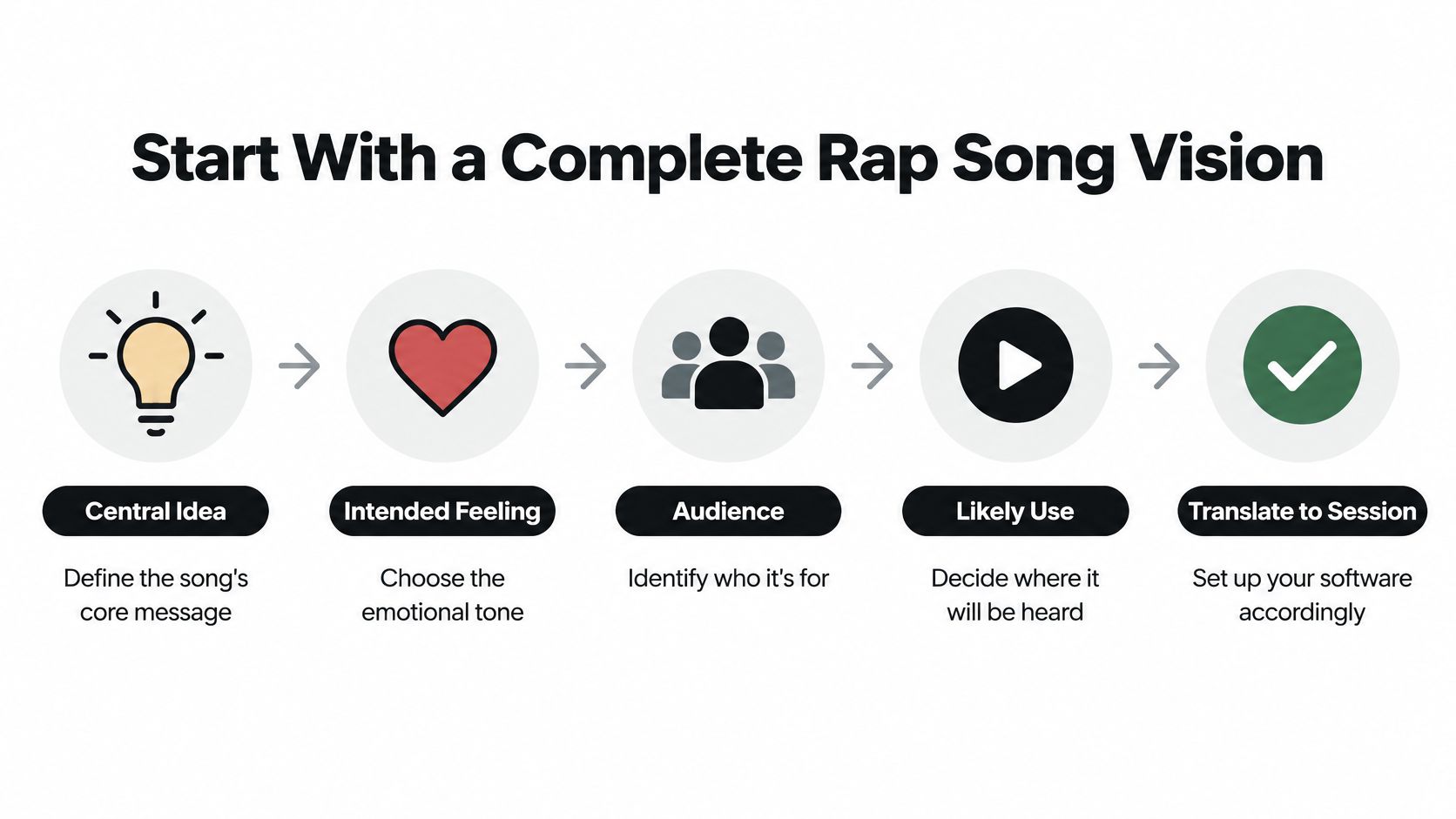
Start by writing a short creative brief in plain language. Name the song's central idea, intended feeling, audience, and likely use. Then translate those choices into practical decisions: what kind of groove supports the feeling, how direct or conversational the delivery should be, where the hook needs to land, and what rights or release preparation the track may require.
Write a brief you can use in the studio
Keep the brief short enough to check while you work. For example: “A tense, self-assured track about getting out of a bad situation. The verses tell the story; the hook gives the listener a phrase to carry away. Keep the vocal close and clear, and make a short excerpt possible without sacrificing the full song's arc.”
That brief doesn't dictate every sound. It gives you a test for decisions. Does a bright synth line support the mood, or distract from it? Does the hook make the central idea easier to remember? If you plan to share a short clip, can the moment stand on its own without making the full version feel like a loop?
Rap's foundation offers a useful reminder that the beat can organize the whole composition. DJ Kool Herc used two copies of the same record to extend a drum break for dancers and MCs at a back-to-school party on August 11, 1973, at 1520 Sedgwick Avenue in the Bronx, a history documented by the Library of Congress. The practical lesson is not to copy a past sound. It's to build around a groove that can hold a performance, then make each later choice serve the song.
Build a Beat Around the Groove
A beat needs a repeatable rhythmic center before it needs extra layers. Begin with a drum pattern you can recognize after it loops, then test whether you can speak naturally over it. If the snare, kick, bass, and melody all compete for attention, the rapper has nowhere to place a clear thought.
Find the pocket before adding detail
Set a tempo that lets you deliver the words without rushing or dragging. Build the kick and snare first, then try several vocal cadences over the pattern. The right tempo isn't a number picked from a genre label; it's the pace at which the intended delivery feels convincing and intelligible.
Loop a short section, such as 8–16 bars, and check whether the groove can support a verse without becoming tiring. Keep the core pattern stable while changing a hat pattern, dropping a drum for a moment, or introducing a melodic accent to signal a transition. Variation should sharpen the arrangement, not hide a weak pocket.
A sparse beat often works better than a crowded one. Give the voice room in the midrange, and avoid writing a bass line that blurs the kick's impact. If a melody is essential to the song's identity, let it repeat with enough space for the rapper's phrases to register.
Choose a production route you can clear
You can make the beat yourself, commission a producer, or adapt an existing track. Each route has a trade-off: building your own offers direct control, commissioning can bring a fresh musical perspective, and adapting a loop can speed up experimentation. In every case, confirm that the material is permitted for your intended use. Sampling copyrighted recordings requires clearance before commercial release, and a license should be checked for its actual terms rather than assumed to cover every use.
If you're shaping the beat in a DAW, explore features that help you sketch, arrange, and revise without losing the core groove. This practical overview of Ableton Live 12 features can help you decide which tools suit your process. For reference practice or a starting point, rap instrumentals can also help you think through how a track creates space for delivery.
Write Lyrics and Flow From Rhythm Out
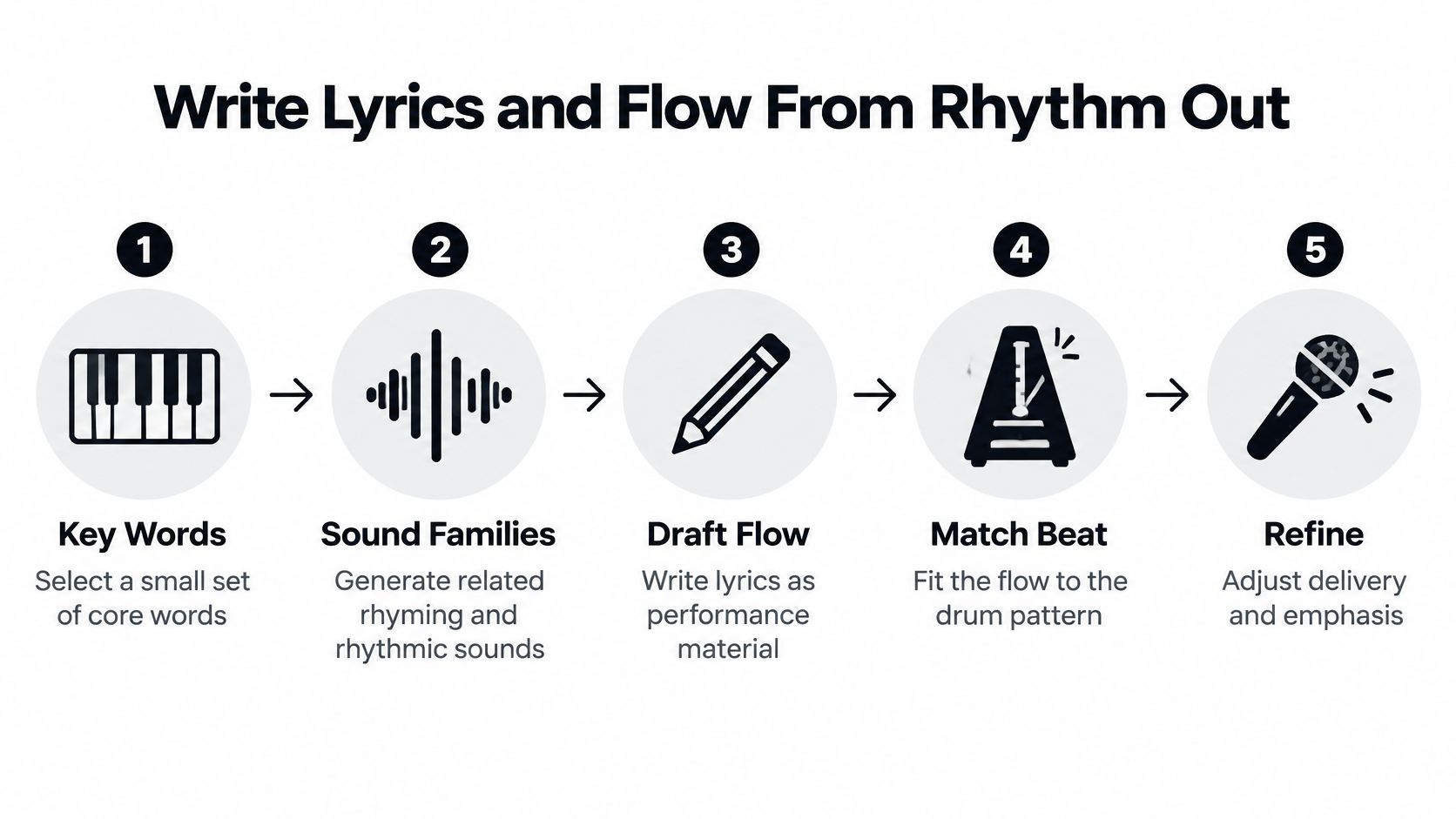
Rap lyrics are performance material, not prose waiting to be squeezed into a beat. Start by choosing a small set of words tied to the song's central idea. Build related sound families around them, then use those sounds to find phrases that express something specific rather than merely completing a rhyme.
A rhyme can land at the end of a line, inside it, or across a line break. Imperfect rhyme is useful when an exact match would force an awkward word or distort the meaning. A University of Manchester analysis reported that rap artists used half-rhyme more than 70% of the time, a finding described in its analysis of rhyme in rap. Treat that as a reminder to listen for useful sound relationships, not as a formula that every verse must follow.
Draft the cadence before polishing the lines
Loop the beat and speak nonsense syllables until a cadence begins to feel natural. Replace those syllables with words that carry the song's message, keeping the stress pattern that made the placeholder phrase work. Then test the line at half speed and at full tempo. If a key word becomes difficult to understand when delivered at the intended pace, rewrite the phrase rather than hoping the mix will rescue it.
Pay attention to three moving parts: how syllables are distributed, where stressed syllables land, and where rhymed sounds occur. Research on rap analysis identifies those as controllable elements, while metrical analysis also considers flow, syncopation, and the way a line carries across a bar. The Northeastern University research material offers a useful foundation for listening closely to those choices.
Leave some beats empty. A pause can make the next phrase hit harder, give the listener time to absorb an image, or leave room for the kick and snare. Enjambment, where a sentence continues across the bar line, can pull the listener forward, but use it deliberately. Mark breath points and keep the verse's main rhythmic motif consistent enough that you can repeat it in a recording session.
Revise for meaning as well as sound
Listen for predictable repetitions and replace them with precise images, verbs, and details drawn from the song's point of view. Internal rhymes can add momentum, while end rhymes can mark a phrase or make a hook easier to follow. Neither should take priority over natural speech. A line may rhyme perfectly and still sound stiff if its stressed syllables fight the groove.
If you want a broader framework for developing a lyric without losing its meaning, this guide to how to craft song lyrics can provide another perspective. Keep the final wording yours. The listener should hear an artist making a choice, not a rhyme pattern filling space.
Record Performances Worth Compiling
A good vocal session captures more than one version of the verse. It gives you options for balancing diction, pocket, emotion, and consonant clarity when you assemble the final performance. Before recording, mark breaths and any cadence that needs to recur consistently. Set the microphone position, use a pop filter, and keep the room as controlled as your setup allows.
Choose a recording level that leaves room for the performance to move. A take that reaches the highest peak isn't automatically the best take. If the vocalist pushes every line at the same intensity, the delivery can lose the tension and release that made the lyrics interesting.
Capture complete takes before punch-ins
Record several full performances before fixing individual lines. Complete takes show how the verse develops emotionally and whether the same flow motif holds together from start to finish. Afterward, record targeted punch-ins for lines that need more clarity or energy. A mic-position note and a brief check of the room can help you keep those replacement phrases consistent with the original takes.
For recording setup ideas, compare your needs with this guide to good microphones for rapping. The microphone matters, but so do distance, room sound, and a performance that fits the beat. A clean capture makes later work easier; it doesn't replace a convincing delivery.
Comp for expression, not peak level
Listen through the takes and choose phrases according to how they communicate. One version may have clearer consonants, another may sit deeper in the pocket, and a third may carry more emotion. Comping means choosing the strongest moments without making the verse sound pieced together. Pay attention to consonants at edits, because a tiny mismatch can make a phrase feel doubled or clipped.
Keep doubles, ad-libs, alternate hook endings, and other supporting parts on separate tracks. That lets you adjust their placement or remove them without damaging the lead. Do not stack layers because the session has room for them. If a double makes the words harder to understand, lower it, move it, or leave it out.
A tightly compressed take can look consistent on a meter and still feel lifeless. Preserve useful changes in intensity, then let the mix address level differences without flattening the performance. Organize track names and takes as you go. Clean session habits save time when you need to revisit a line during editing or arrangement.
Mix for Clear Words and Controlled Impact
A mix that buries the words wastes the work done in writing and recording. Treat the lead vocal as the mix's intelligibility target: the listener should catch every bar while still feeling the weight of the beat. Start with clean gain staging, timing cleanup, and noise control, then process only what the recording needs. Plug-ins don't improve a vocal just by being present.
Use processing to solve a specific problem
Subtractive EQ can cut low-frequency rumble or a buildup that clouds the voice. Moderate compression can make level changes easier to manage, and de-essing can tame sharp sibilance. Use reverb and delay with restraint. Short ambience can give the vocal depth without pushing it behind the beat; a long, wet tail may blur the next phrase.
Keep the lead centered and let doubles and ad-libs add width only where they serve the arrangement. If you use noise removal or stem separation, listen for metallic or watery artifacts. Aggressive cleanup can strip the texture you wanted to keep along with the noise. Timing edits need the same caution: tighten a phrase where it distracts, but don't erase a deliberate rhythmic push or pull.
Make room in the beat
When the vocal is hard to hear, more fader is rarely the right first move. Check whether melodic parts occupy the same midrange as the voice, then carve space where needed. Listen for kick and 808 overlap, because excess low-end energy weakens both definition and impact. Automate the verse and hook separately when the arrangement calls for different emphasis.
Research into rap delivery describes syllable distribution, accented syllable locations, and rhyme placement as controllable variables, along with tactus, enjambment, flow, and syncopation. Those are not just writing concerns. The mix should preserve the details that make the delivery work, as covered earlier in the metrical and rap-analysis research.
Before mastering, check the mix for clipping, excessive compression, low-end buildup, masked consonants, and lost headroom. Compare it at low volume, on headphones, and on speakers. A professionally mixed reference can help you judge tonal balance, but compare at matched loudness so the louder track doesn't win just because it's louder.
Use AI Without Losing Artistic Control
AI can help with bounded tasks, but the artist should own the concept, lived experience, final wording, and performance. A 2025 survey of more than 1,200 global music makers found that 87% had incorporated AI somewhere in their process, while 29% used song generators; more than 90% of surveyed UK music creators supported safeguards around consent, compensation, labeling, and protection of voices and images, according to the survey coverage. The useful question is not whether to use AI at all. It's how to use it without handing over the song's identity.
Keep the comparison artist-led
An artist-led process begins with a human premise: a place, memory, conflict, character, or point of view. AI can then suggest several hook directions, alternative transitions, or ways to vary syllable density. Treat those suggestions as raw material. Rewrite them in your own vocabulary, remove generic phrasing, and check that every line supports the story.
An AI-led approach can produce a fast draft, but speed can come at the cost of voice. A phrase may scan neatly and still sound like something anyone could say. If it doesn't reflect the artist's language or experience, revise it or discard it. Keep track of meaningful edits so you can explain what you contributed and review the output for originality before release.
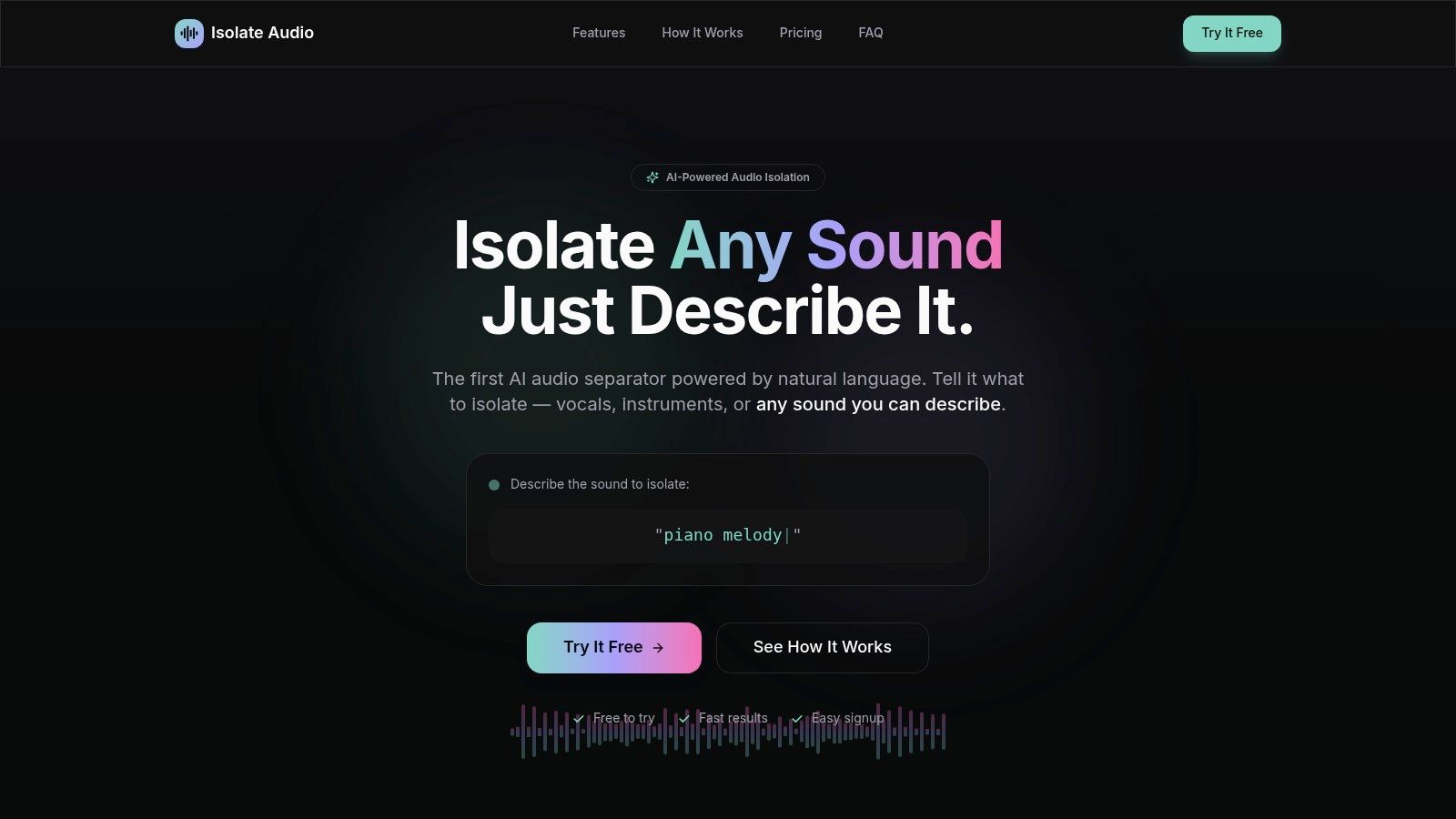
AI can also assist with reference study. For example, separating an element from a recording can help you hear how a vocal, drum break, or other sound works in context. It doesn't grant permission to sample or commercially release copyrighted material. Use reference material to learn, and confirm rights before using any source in a released track.
Here's a demonstration of an audio-isolation workflow:
Check authorship, source material, and disclosure
Before release, review where any AI-assisted lyrics, vocals, or source material came from. Don't imitate a real artist's voice or use someone's recording without permission. Document your edits and confirm the applicable consent and rights requirements. Decide whether disclosure or labeling is appropriate for the release and its context.
A useful standard is simple: let AI offer options, but keep the decisions that define the song with the artist. The song should still sound like the person who chose the subject, shaped the story, rejected the weak suggestions, and performed the final lines.
Prepare the Song for Release and Discovery
A finished mix needs to work as a complete song, not just as an appealing loop. Listen from the opening through the ending and ask whether the verses develop the idea, the hook delivers a payoff, and any bridge or beat switch earns its place. If a section repeats without adding energy, information, or contrast, consider cutting or revising it.
Short-form discovery creates a different arrangement problem. Creator-economy research found that 27% of creators prioritize songs with strong hooks for short-form content, while another 27% prioritize consistent songs with good flow for longer-form content, according to the creator-economy report coverage. That balance points to a practical choice: make a memorable excerpt available without turning the full track into an unfinished clip.
Shape a full song and a usable excerpt
Find the strongest moment, such as a hook, a revealing line, or a beat change, and test it as a concise 10–20-second excerpt. It should make sense when heard without the surrounding verse, while still representing the song accurately. If the listener needs context, include a clear lyric or musical cue that helps the moment stand on its own.
Then return to the full arrangement. A recognizable opening can establish the track's identity, but the song still needs development after the excerpt-worthy moment. Build the verses toward the hook, vary the production when the story shifts, and avoid repeating a short-form section so often that the longer version feels static. Prepare a clean edit when the language or context calls for one, and check that edits don't cut off a rhyme, breath, or musical transition.
Clear the details before you distribute
Make a release checklist that covers ownership, samples, beat terms, collaborators, credits, and any AI-related disclosure decisions. Check that you have permission for the backing track and any material incorporated into the recording. Confirm the spelling of artist names, song title, contributor credits, and release assets before sending the track to a distributor. This guide to music distribution can help you understand the practical path from finished audio to a release.
Finally, plan a small set of content that extends the song's story. One post can introduce the central idea; another can show how a lyric or beat choice came together; a short excerpt can give the hook a clear entry point. Keep alternate versions and files organized so you can provide the right edit when a platform, collaborator, or listener needs it. The goal isn't to make the song serve one format. It's to make the release easy to understand, share, and hear in full.
Isolate Audio lets creators isolate a sound from an audio or video recording using a plain-language prompt, with separate outputs for the chosen sound and the remaining audio. Try it to study a reference, prepare a practice vocal, or inspect a beat's layers, then visit Isolate Audio to explore the tool.