Sound Isolation vs Noise Cancellation Explained
You're about to record a clean vocal take when a café grinder starts up, a train rolls past the window, or the HVAC system adds a low mechanical rumble beneath the room tone. You put on noise-cancelling headphones, but the grinder still cuts through. You switch to tightly sealed in-ear monitors, and the rumble becomes less dominant, but you lose awareness of the room. Neither choice is wrong. The problem is using one solution for a noise profile it wasn't designed to control.
Sound isolation and noise cancellation reduce unwanted sound through different mechanisms. Isolation uses a physical barrier, seal, or enclosure. Active noise cancellation, usually called ANC, uses microphones, processing, and an opposing signal. For creators, that distinction affects recording, monitoring, editing, hearing protection, and the quality of the final track.
| Aspect | Passive sound isolation | Active noise cancellation |
|---|---|---|
| Primary mechanism | Physical seal, mass, density, and damping | Microphones, processing, and an opposing acoustic signal |
| Strongest use | Speech, transients, higher-frequency leakage, stage volume | Steady low-frequency rumble and mechanical noise |
| Power requirement | None for the isolation effect | Battery or external power required |
| Latency risk | None | Possible processing delay or artifacts |
| Main weakness | Low-frequency vibration can pass through the structure | Sudden, complex, or high-frequency sounds are harder to cancel |
| Creator priority | Reliable monitoring and recording control | Comfortable monitoring in consistently noisy spaces |
The practical answer to sound isolation vs noise cancellation isn't “which technology is better?” It's “where in the production chain does the unwanted sound enter, and what frequencies dominate it?”
Understanding the Core Differences in Audio Blocking
A podcaster records an interview in a busy café. The headphones are expensive, the microphone is close to the guest, and ANC makes the room feel quieter to the person monitoring. The recording still contains cups clinking, nearby speech, and abrupt grinder noise because ANC changes what the listener hears. It doesn't prevent those sounds from reaching the microphone capsule.
A vocalist working beside an HVAC vent faces the opposite problem. A well-sealed pair of closed-back headphones can reduce some of the room leakage reaching the vocalist's ears, but it won't stop the microphone from capturing the vent's low-frequency energy. The best hardware choice depends on whether the unwanted sound is affecting the performer, the microphone, the monitor mix, or all three.
Practical rule: Reduce noise at its source or transmission path before trying to repair it in software.
Isolation is a physical boundary
Passive isolation limits the route sound takes through the air and through materials. Earpads press around the ear, in-ear tips seal the canal, and recording enclosures use barriers and absorptive construction to reduce transmission. The result depends on fit, contact, material properties, and gaps. There's no microphone, processor, or anti-noise signal involved.
A useful explanation of the distinction appears in this sound isolation guide for creators, which treats isolation as a physical control problem rather than a playback feature. The same principle applies outside headphones. Anyone assessing windows, doors, or room boundaries can also consult Superior Home Improvement insulation experts for a building-focused perspective on physical sound transmission.
Cancellation is a targeted electronic response
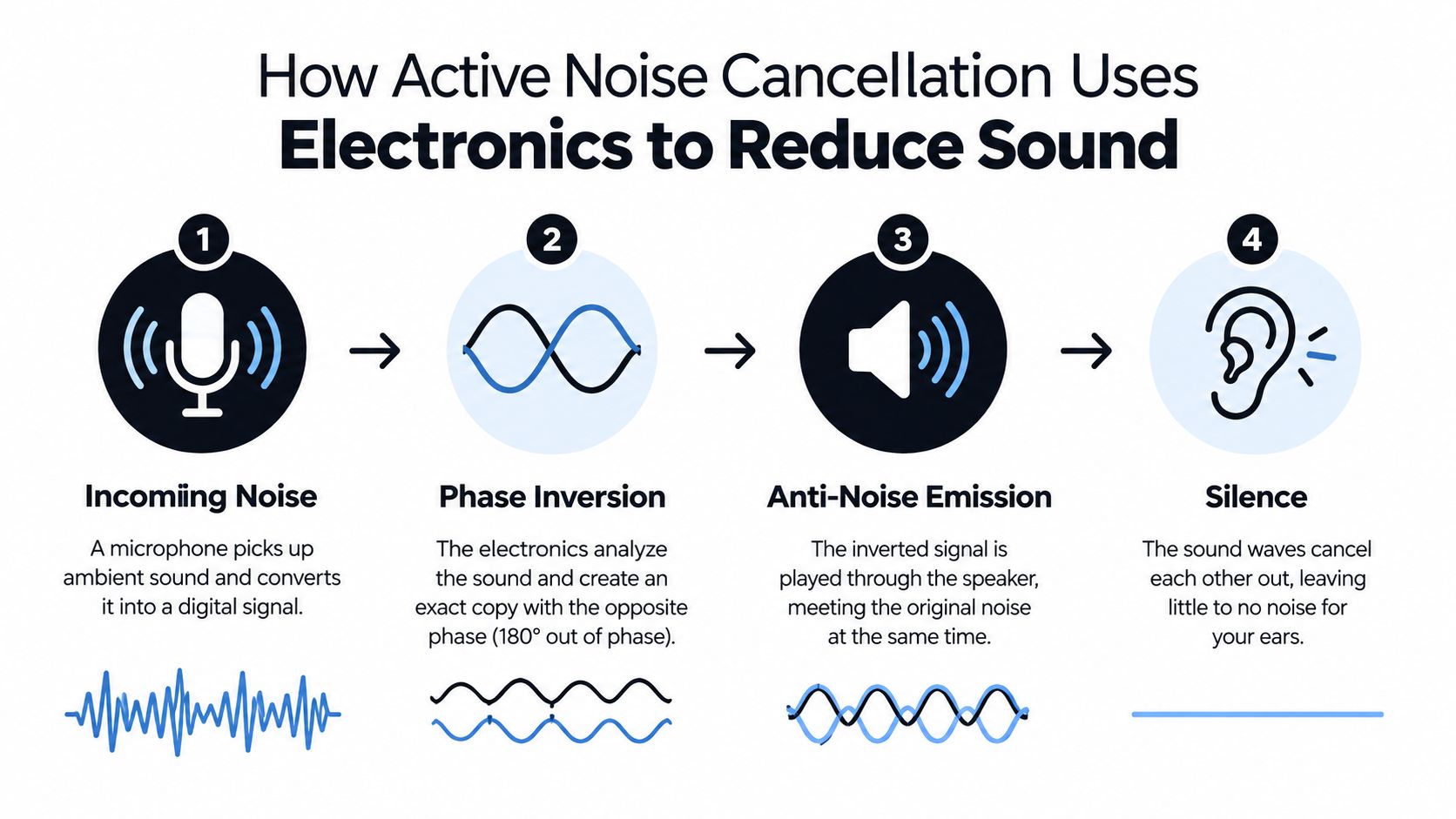
ANC starts with microphones that detect surrounding sound. A processor estimates the unwanted waveform and sends a controlled opposing signal through the headphone drivers. Where the original and opposing signals meet in the listening area, the perceived result can be reduced.
That process works best when the noise is predictable, continuous, and concentrated in a range the system can track effectively. It doesn't create a universal silence field around a room, and it doesn't erase sound from a microphone recording just because the engineer is wearing ANC headphones.
A frequently missed point in consumer comparisons is that the two methods solve different frequency problems. Business Insider's headphone guidance also frames isolation and cancellation as complementary approaches rather than a simple either-or purchase. In a creator workflow, a sealed headphone can control monitoring leakage while ANC can make a train or aircraft more comfortable during editing. Neither replaces a quiet recording space.
How Passive Sound Isolation Physically Blocks Audio
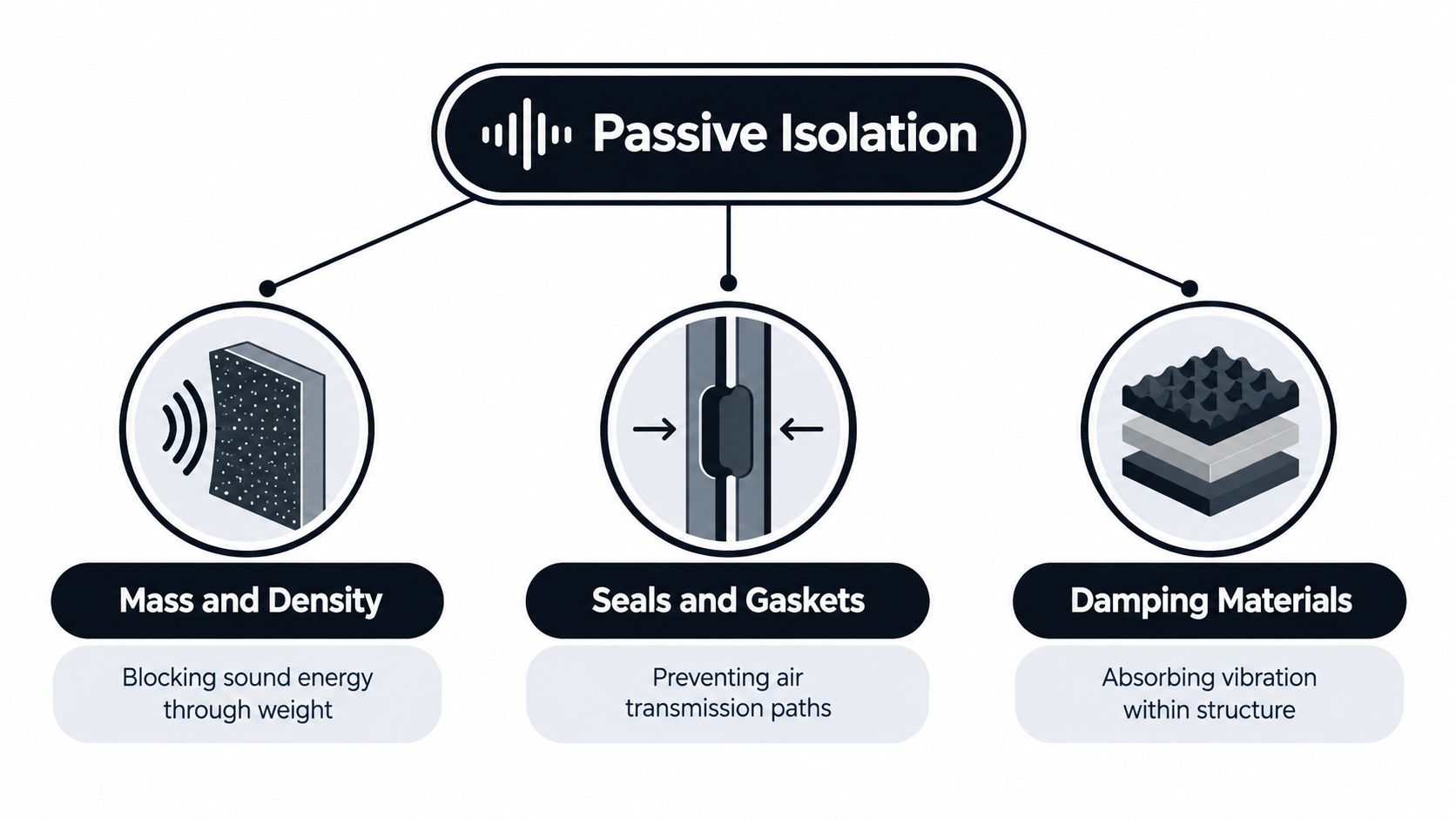
A microphone does not distinguish between wanted and unwanted sound once both enter the recording path. Passive isolation addresses that path physically. Dense materials resist acoustic energy, sealed joints stop air movement through gaps, and damping layers limit vibration within a panel or enclosure. Headphones apply the same principles at a smaller scale through earcups, pads, ear tips, and internal construction.
Fit matters more than the product label
Over-ear headphones need steady pad contact around the entire ear. Glasses, hair, worn cushions, or uneven clamping create leakage paths that reduce isolation. A closed-back model can appear substantial yet perform poorly if its pads cannot maintain a continuous seal.
In-ear monitors depend even more on fit. The tip must close the ear canal without causing pain, and the shell must stay stable as the performer moves. A well-fitting sound-isolating IEM can reduce ambient noise by about 20 to 30 dB, according to this explanation of passive sound isolation. That range describes a good seal, not a guaranteed result for every ear, tip, or listening position.
Decibel attenuation is logarithmic, so a rating is not a percentage reduction. The same explanation notes that a 20 dB reduction corresponds to sound pressure at roughly one-tenth of the original level, while 30 dB corresponds to roughly one-thousandth. A broken seal can reduce real-world performance sharply. For creators, checking the fit during movement matters more than choosing a product from its packaging claim.
Why passive isolation remains valuable
Passive isolation needs no battery, active processing, or monitoring delay. Sealed IEMs can reduce stage energy while a drummer monitors a click. Closed-back headphones can limit cue-track spill near a vocal microphone. Editors can also use passive headphones when sudden room sounds would otherwise disrupt critical listening.
The trade-off appears at low frequencies and through solid structures. A sealed earcup can reduce airborne detail, while vibration from a vehicle floor, building, or HVAC system may still travel through the body, chair, desk, or headphone frame. Passive materials reduce the overall transmission path rather than selecting one sound to remove while preserving another. That can protect hearing and improve monitoring, but it also reduces conversation and environmental awareness.
True separation in a creator workflow often needs more than physical isolation. Isolation can keep spill out of a microphone, while post-production AI tools may separate overlapping voices, room tone, or unwanted sources after recording. Use those tools to address what the physical setup could not prevent.
A lab rating is only a starting point. The explanation of OSHA-style real-world adjustment notes that a laboratory-rated 25 dB NRR can translate to roughly 9 dB of practical noise blocking after everyday-use adjustments. Seal quality, placement, movement, and the actual recording environment determine the result.
How Active Noise Cancellation Uses Electronics to Reduce Sound
ANC adds an electronic control loop to the listening chain. External or internal microphones capture the surrounding field, a processor analyzes the incoming signal, and the headphone drivers emit an opposing waveform. The system aims to reduce the sound at the ear, not to remove the original sound from the room.
That distinction explains why ANC is so effective on an aircraft or beside a steady fan. The microphones can observe a relatively stable pattern, and the processor can generate a response before the sound reaches the ear. In a chaotic café, the system has less time and less predictability. Speech, clattering objects, footsteps, and sudden impacts change rapidly and arrive from different directions.
ANC targets predictable noise
A pilot REM study measured the greatest ANC attenuation at 250 Hz, 18.1 ± 1.6 dB, with attenuation falling to roughly 1 to 5 dB from 500 to 2,000 Hz and becoming negligible above 3 kHz, at 1 dB or less. The published study on ANC frequency performance makes the practical limitation clear. ANC is strongest against low-frequency, steady noise, not every sound that makes it into the room.
That's why ANC can make a train journey feel dramatically calmer while doing little to remove a nearby person's consonants or a snare hit. It may reduce the low mechanical bed beneath a recording session, but it won't reliably prevent a microphone from capturing a door slam. The listener may hear a cleaner monitoring environment while the recorded file remains unchanged.
Processing changes the monitoring experience
ANC requires active electronics and power. The processing path can introduce tonal changes, pressure sensations, pumping, or artifacts, especially when the system adapts aggressively to changing conditions. Those effects may be acceptable for travel and rough editing but distracting during critical mixing or performance monitoring.
Creators who need to understand the trade-off between immediate sound and computed processing should also consider real-time audio processing principles. Monitoring latency matters when a performer hears their own voice or instrument through a live signal path. Even a small delay can make timing feel unstable, so ANC headphones aren't automatically suitable for tracking.
ANC became a mainstream headphone feature after moving from specialized aviation and military applications into consumer products in the 2000s and 2010s. Market estimates place the ANC headphone sector at about USD 14.5 billion in 2025, with one projection reaching USD 35.3 billion by 2034 at a 10.13% CAGR, while another forecast places it at USD 20.38 billion in 2025 and USD 44.76 billion by 2031. These estimates, reported in IMARC's ANC headphone market analysis, show adoption and market scale, not proof that ANC is the right tool for every recording situation.
Comparing Performance Across Frequencies and Environments
Frequency determines the result more reliably than marketing language. Passive isolation often performs well against higher-frequency airborne sound when the seal is intact. ANC tends to contribute more against steady low-frequency energy, where a processor has enough time to estimate and counter the repeating pattern.
| Frequency band | Passive isolation performance | ANC performance | Common noise sources |
|---|---|---|---|
| Low frequency | Can struggle when vibration travels through structure or the body | Usually strongest when the noise is steady and predictable | Engine rumble, HVAC, train movement |
| Lower midrange | Depends heavily on seal, enclosure, and material construction | Can provide partial reduction when the source remains stable | Bus interiors, machinery, room ventilation |
| Midrange | A good seal can reduce some airborne speech and room leakage | Usually less consistent with changing voices and reflections | Conversations, office activity, acoustic instruments |
| High frequency | Physical barriers and seals can be effective against many sharp details | Often limited, especially with abrupt or complex events | Cymbals, clicks, clatter, consonants |
| Transients | Physical sealing can reduce the direct airborne impact but cannot remove structural vibration | Poor match for sudden events that change before processing can respond | Snare hits, doors, dropped objects, dog barking |
A creator shouldn't read the table as a promise of perfect separation. The source position, earcup geometry, seal quality, room reflections, and microphone placement all change the result. A microphone placed near the noise source will capture energy before headphone design can help.
Measurement needs more than one dB figure
Headset testing can report overall attenuation in decibels, but that single number can hide the frequency response. AudioXpress's discussion of isolation measurement also describes psychoacoustically weighted loudness reduction in phons and the Speech Intelligibility Index, or SII, which estimates how much speech remains understandable in noise.
Those metrics answer different production questions. Overall attenuation indicates how much sound level changes. Loudness reduction reflects how listeners perceive that change. SII matters when a podcast producer needs to know whether speech remains intelligible, not merely whether the room became quieter.
The right test is not “How quiet does this headphone sound?” It's “Can I make the decision I need to make while wearing it?”
For a mixing engineer, the key issue is signal-to-noise judgment. A signal-to-noise ratio guide for audio workflows provides the broader framework: unwanted sound can mask detail, but lowering the perceived room noise at the monitoring position doesn't automatically improve the recorded signal. Evaluate the file itself, not just the comfort of the monitoring session.
Practical Workflows for Musicians and Content Creators
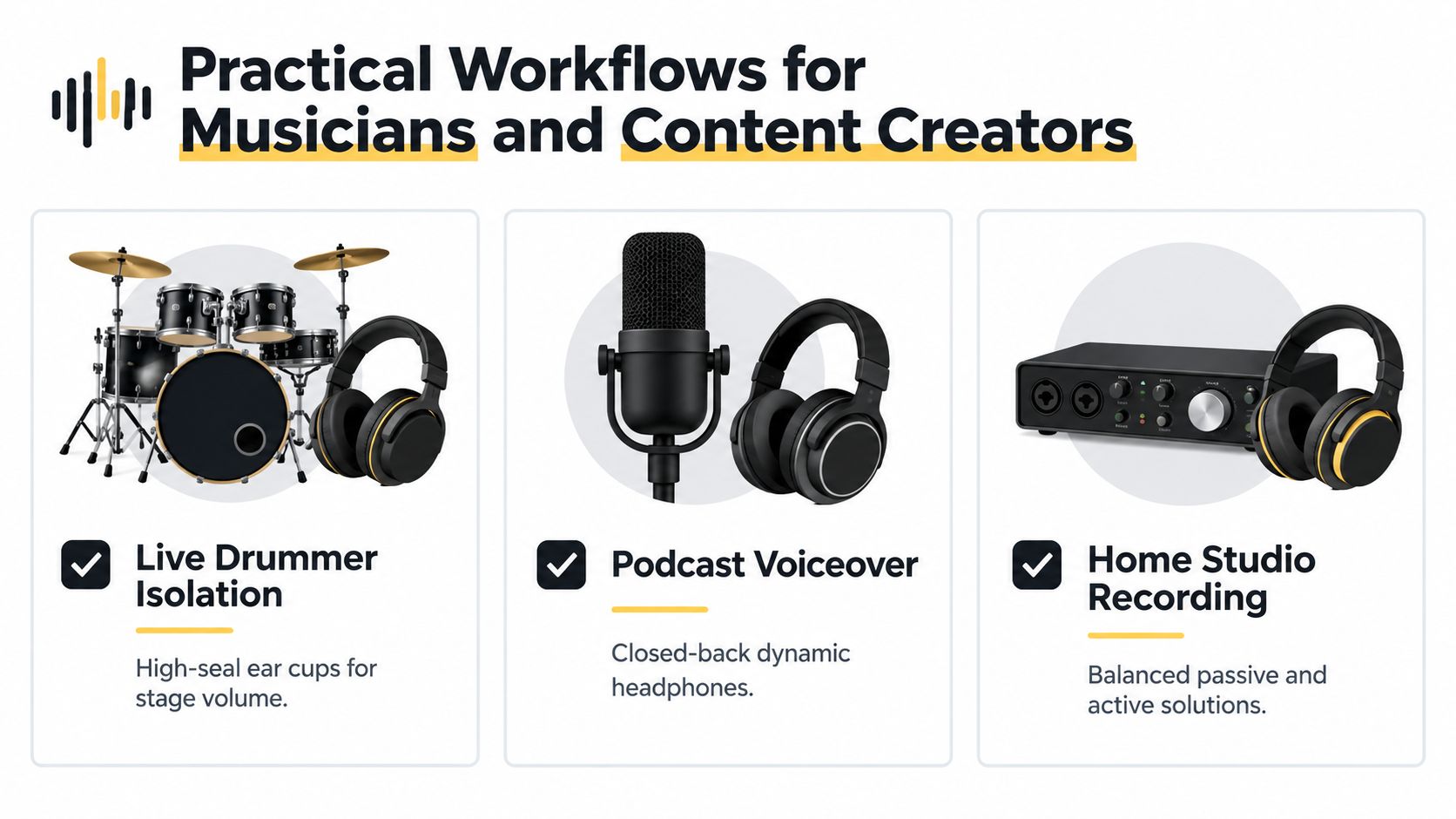
Hardware choices become clearer when the workflow is specific. A touring drummer, a solo podcaster, and a video editor in an untreated room don't have the same noise problem, so they shouldn't build the same monitoring chain.
For live musicians
A drummer needs reliable passive isolation first. Use properly fitted IEMs or high-seal closed-back headphones, feed the click and monitor mix at a controlled level, and check that the seal stays stable during movement. ANC can be useful during travel to and from the venue, but it isn't a substitute for stage monitoring designed around timing, isolation, and hearing protection.
A vocalist tracking beside a loud instrument should also prioritize passive isolation in the cue mix. Keep the headphone level only as high as necessary, place the microphone close enough to improve the direct-to-room balance, and verify spill with a short test recording before committing to a full take.
For podcasters and interview hosts
A host needs to hear their own voice, the guest, and technical problems without becoming disconnected from the room. Closed-back headphones provide useful passive separation during recording, but transparency or ambient modes can help during setup and collaboration. Don't leave maximum isolation enabled when you need to respond to a producer, hear a warning, or monitor the space around a field interview.
ANC headphones can make a noisy commute or editing session more comfortable, yet they don't clean the source file. Record a room tone pass, move the microphone away from reflective or mechanical sources, and keep a backup take when the environment is unpredictable.
For editors and field recordists
An editor working in an untreated home studio benefits from comparing the same passage on passive closed-back headphones, ANC headphones, and speakers. If a low rumble disappears only when ANC is active, check the waveform and spectrum before making EQ or noise-reduction decisions. Otherwise, you may remove useful low-end information because your monitoring system hid it.
Field recordists need the opposite discipline. Total isolation can conceal traffic, approaching people, equipment faults, or ecological cues. Transparency modes are increasingly treated as expected features in premium headphones, and recent market coverage of ambient-awareness modes describes a shift toward adjustable awareness rather than maximum cancellation at all times. Use awareness when safety or collaboration matters, then audition the recording itself with a neutral monitoring setup.
Leveraging Post-Production Tools for Perfect Audio Separation
Hardware controls what reaches the listener during monitoring. It doesn't guarantee what reaches the microphone. Once a café conversation, room reflection, traffic burst, or overlapping instrument is printed into the recording, passive isolation and ANC can no longer change the original capture without affecting the performance.
That's where post-production separation becomes useful. Traditional stem tools usually expect fixed categories such as vocals, drums, bass, or accompaniment. Modern AI separation can work from a described target, which is more practical when the unwanted element is a specific sound rather than a standard musical stem.

Use separation after prevention
A sensible workflow starts with prevention. Choose the right microphone pattern, move the source away from HVAC vents, close windows, use a stable headphone seal, and record a clean reference of the environment. Post-production should rescue imperfect material, not encourage careless recording.
When prevention falls short, upload the audio or video to Isolate Audio, describe the target in natural language, and review both outputs, the isolated element and the remaining audio. The service supports files such as MP3, WAV, FLAC, M4A, OGG, MP4, and WebM, with Best, Balanced, and Fast quality presets plus a Precision Mode for difficult overlapping sources.
A podcaster might target a speaker's voice while retaining the remainder for comparison. A producer could extract a piano melody from a dense arrangement to build a practice part. A video editor might isolate dialogue or reduce a specified background sound before applying conventional EQ, compression, and noise reduction.
Listen for artifacts, not just loudness
AI separation can produce swirls, clipped consonants, watery ambience, or missing transients when sources overlap heavily. Audition the isolated file in context, compare it with the original, and use short crossfades where the separation creates unstable edges. Don't assume a quieter background is automatically a more natural result.
Cloud processing can also reduce the need for local installation and make separation available across a team's editing workflow. The important decision remains editorial: preserve the character of the speaker, instrument, or environment, and remove only what the final piece can afford to lose.
Making the Right Choice for Your Specific Audio Needs
Start with the noise profile, not the product category.
| Your main problem | First choice | Why |
|---|---|---|
| Steady engine or HVAC rumble during travel or editing | ANC headphones | Electronics target predictable low-frequency noise |
| Voices, clatter, cymbals, or stage spill | Passive isolation | A stable seal limits airborne leakage without processing |
| Live performance monitoring | High-seal passive IEMs or closed-back headphones | Timing and reliable fit matter more than ANC convenience |
| Recording in an uncontrolled environment | Better placement and physical isolation | Headphone cancellation won't stop the microphone from capturing noise |
| Overlapping sounds already printed into a file | AI audio separation in post | Software can target a selected element after recording |
| Need for warnings, conversation, or environmental awareness | Transparency or ambient mode | Adjustable awareness can be safer and more practical than maximum isolation |
Budget should follow the point of failure. If the performer can't hear the click, improve passive monitoring. If the editor is distracted by a train or fan, ANC may improve comfort. If the microphone already captured the unwanted sound, spend time on placement and post-production rather than expecting headphones to repair the file.
The strongest workflow is often hybrid. Use physical isolation to protect the recording and preserve low-latency monitoring, ANC for predictable background rumble during travel or rough editing, transparency when awareness matters, and post-production separation when overlapping sources survive the capture.
Use Isolate Audio to target specific sounds in audio or video with natural-language prompts, then download the isolated element and the remaining audio for editing. Upload a compromised interview, rehearsal, field recording, or video track and test whether targeted separation can solve what physical isolation and noise cancellation couldn't prevent.