Styles of Rap Explained: Sounds, Origins and Differences
If a track has trap drums, a sung chorus, and socially conscious lyrics, which style of rap is it? A conventional genre list might offer competing answers because those labels describe different things: production, vocal delivery, and subject matter.
The most useful way to understand styles of rap is to treat a label as a starting point, then test it against what you hear. Listen for the drums, bass, placement of syllables, vocal layers, and regional context. You don't need to recognize an artist's voice to describe a track accurately.
The Major Rap Styles at a Glance
Major rap styles: origin, era and defining traits
| Style | Origin | Era | Defining traits |
|---|---|---|---|
| Boom bap | New York City | Sample-centered rap tradition | Sampled drum breaks, hard snares, dense rhyme schemes |
| Party and humorous rap | New York and nationwide | Early commercial rap onward | Crowd participation, playful wordplay, upbeat hooks |
| Gangsta rap | Los Angeles and the West Coast | West Coast breakthrough period | Street narratives, forceful delivery, hard-edged production |
| G-funk | Los Angeles and the West Coast | Following gangsta rap's rise | Funk-derived grooves, prominent bass lines, synth leads |
| Miami bass | Miami | Regional dance-rap development | Booming drum-machine bass, dance-focused rhythms |
| New Orleans bounce | New Orleans | Regional dance-rap development | Call-and-response chants, bouncing rhythms |
| Chopped and screwed | Houston | Southern regional expansion | Slowed playback, chopped and repeated phrases |
| Crunk | Atlanta and the South | Southern club-rap expansion | Shouted hooks, high energy, heavy bass |
| Trap | Atlanta | Regional development into mainstream adoption | Deep Roland TR-808 bass, intricate percussion, street narratives |
| Drill | Chicago | Following trap's development | Stark repetition, confrontational lyrics, bass-heavy production |
| Conscious rap | Nationwide | Early stylistic branching onward | Social and political themes, argument, storytelling |
| Melodic rap | Cross-regional | Rap and sung-vocal crossover | Pitched phrases, sung hooks, R&B-influenced delivery |
| Pluggnb | Online production and sample-pack communities | Internet-centered production era | Dreamy melodies, bright pitched textures, soft drums |
Read origin as historical context, not a rule about where an artist must live. The era column describes a stage of development rather than a fixed expiration date. Producers can revisit an older approach or combine it with a newer one.
The traits column is your listening checklist. A sampled break alone doesn't establish boom bap, but that break alongside a prominent snare and tightly organized rhymes makes the description more useful. For a closer production reference, examine the relationship between kick, snare, and sample in a boom bap drum pattern.
Use families without turning them into boxes
For an initial comparison, group sample-centered boom bap and some conscious rap together; place bass-centered Miami bass, crunk, trap, and drill alongside one another; and compare melody-centered melodic rap and pluggnb. G-funk can fit both sample-centered and bass-centered listening.
These are listening families, not official boundaries. Conscious rap identifies lyrical purpose more than a particular beat, while melodic rap identifies a delivery approach. A conscious verse can sit over trap production, and a melodic hook can appear in drill.
Practical rule: Confirm a label with a cluster of audible traits, not a single instrument or lyrical topic.
Where the Styles Came From
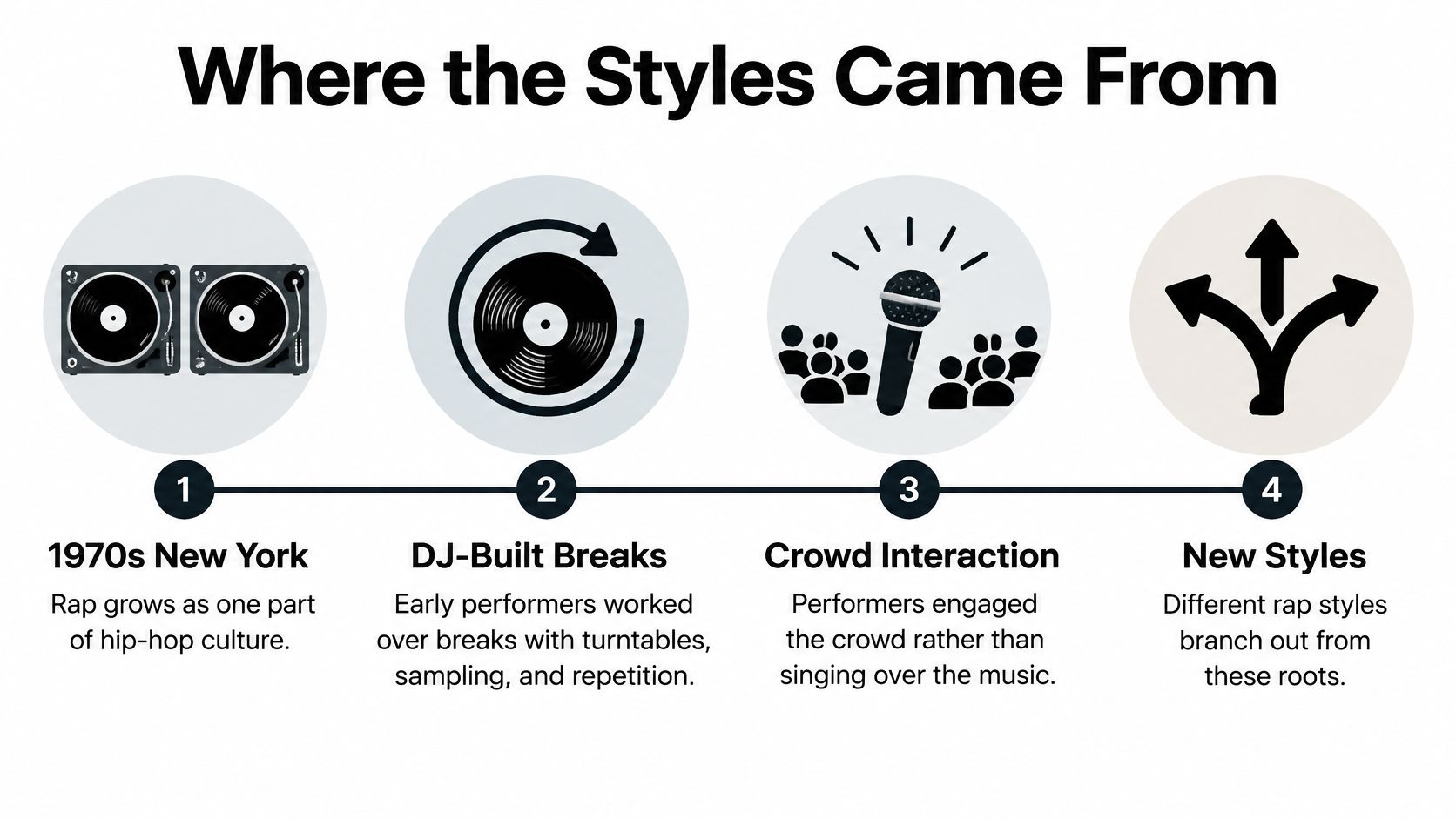
Rap's family tree begins with performers and DJs working together, not with a catalogue of subgenres. Britannica's history of rap traces its development to African American communities in New York City during the 1970s, as part of the broader culture of hip-hop.
DJs supplied rhythmic breaks, and performers used spoken delivery, repetition, and crowd interaction. That division of labor helps explain why a rap recording can have a distinctive vocal style over an independently distinctive backing track.
The diagram outlines those shared roots.
Follow the branching points
- Neighborhood performance: The DJ's repeated break gave the rapper a rhythmic foundation. The performer could address dancers directly, stretch a phrase, or invite a response.
- Recorded breakthrough: The Sugarhill Gang's Rapper's Delight brought the form to broad national attention. Rap could reach listeners who weren't present at the party.
- Stylistic branching: New-school performers favored more direct song structures and pop accessibility. Run-D.M.C. connected rap with rock-oriented production and performance.
- Regional distinction: West Coast gangsta rap and G-funk established recognizable combinations of storytelling, groove, and musical texture.
- Southern expansion: Local approaches to dance, bass, vocal energy, and playback manipulation became central parts of rap's vocabulary.
Think of these developments as branches rather than replacements. Party rap didn't disappear when socially conscious writing gained visibility, and technically intricate verses didn't eliminate conversational storytelling. Performers kept choosing different relationships between audience, words, and beat.
The production roots remain especially clear in sampling in hip-hop. A repeated musical fragment can provide continuity while the rapper changes rhyme placement, intensity, or narrative perspective.
That historical reach still matters commercially: according to Hit Songs Deconstructed's report, hip-hop/rap represented 38% of Billboard Hot 100 No. 1 songs in 2024. For listening purposes, though, lineage is more useful than chart position. Ask which performance tradition and production approach the recording draws upon.
How Regional Scenes Reshaped the Sound
A regional scene leaves fingerprints you can measure. DJs, producers, dancers, and rappers in one city build connected habits: which sounds dominate an arrangement, how phrases repeat, and how much room a vocalist leaves between lines.
Carnegie Hall's rap and hip-hop timeline describes rap's strong regional diversification from the mid-1980s onward, naming Miami bass, New Orleans bounce, Houston chopped-and-screwed music, and Atlanta crunk and trap.
Southern scenes and their audible signatures
Miami bass puts low-frequency impact near the center of the arrangement. Before applying the label, check whether the bass pulse and the dance rhythm drive the record together; a bass-heavy mix on its own is not proof.
New Orleans bounce directs attention toward chants and participation. Ask whether the vocal phrases seem built for a crowd to answer, and whether repetition is what organizes the groove.
Houston chopped-and-screwed music changes the listening experience through slowed playback and deliberate cuts or repetitions. The clue is the treatment of recorded material, not a rapper merely delivering words slowly.
Atlanta crunk and trap offer a useful contrast within one city. Crunk emphasizes collective vocal energy and shouted hooks, while trap puts particular weight on deep bass and detailed drum programming. Studying trap drum patterns helps you separate the underlying pulse from rapid decorative percussion.
Houston, Atlanta, New Orleans, and Memphis are important Southern reference points. Treating them as one Southern sound erases the contrasts you just tested for.
West Coast groove and Chicago restraint
For G-funk, follow the bass as a musical line. Does it move through a groove beneath the rapper rather than strike and hold a low note? Then listen for the surrounding funk-derived texture. A West Coast artist catalog such as the option to discover E-40 exclusives for fans can supply extra reference tracks once you know what to listen for, but treat artist resources as context and still confirm each label by comparing recordings.
For Chicago drill, test the combination of stark repetition, vocal cadence, and confrontational subject matter together. A sliding bass sound by itself establishes neither Chicago lineage nor the difference between an original scene and a later adaptation.
Two tracks can share a tempo yet feel unrelated because their bass articulation, percussion, and vocal phrasing differ.
Try a listening test: play the introduction with the vocals muted and write down a regional hypothesis from the bass treatment and percussion alone. Then bring the voice and track credits back in to confirm or revise it.
How Flow Places Rappers on the Beat
Flow is the coordinated timing of syllables, stresses, rhymes, and articulation against a beat. It isn't just speed: a rapper can deliver densely packed words while the backing track maintains an unhurried pulse.
Kyle Adams's analysis in Music Theory Online examines rhyme placement, syncopation, articulation, and metrical relationships, including the funk-derived backbeat that emphasizes beats 2 and 4. Rappers create contrast by placing vocal attacks on, ahead of, or behind the expected pulse.
Delivery types and where syllables land
| Delivery | Where syllables land | Typical feel | Common in |
|---|---|---|---|
| Grid-aligned | On the beat and its subdivisions | Tight and precise | Dense boom bap verses |
| Conversational | Around the beat in speech-like phrases | Relaxed and narrative | Laid-back narrative rap |
| Triplet-based | Across evenly spaced triplet subdivisions | Rolling and bouncy | Trap and drill flows |
| Behind the beat | Just after the expected pulse | Deliberate and relaxed | Melodic and laid-back styles |
| Syncopated | On unexpected subdivisions, with shifted accents | Off-center and rhythmically active | Technical and dense rap |
These are descriptions, not exclusive categories. A rapper can begin conversationally, tighten into the grid, then delay a rhyme ending.
Analyze a verse in your audio editor
- Mark the bars and subdivisions. Use a digital audio workstation such as Audacity or REAPER. Establish the recurring pulse before drawing conclusions from the waveform.
- Locate syllable starts. Listen for consonant attacks. A sustained vowel may continue across a beat even though the syllable began before it.
- Count stressed syllables within each bar. This reveals where the performer concentrates emphasis. Don't confuse loudness from compression with linguistic stress.
- Measure the gaps. Note the pauses between phrases. Silence helps distinguish spacious phrasing from nearly continuous delivery.
- Mark rhyme positions. Check whether rhyming sounds repeatedly arrive at expected boundaries or interrupt them.
A sparse delivery leaves room around the backbeat. A dense delivery fills more subdivisions without necessarily changing the tempo.
For an additional comparison exercise, you can browse AI-generated rap tracks through Vocuno and annotate the timing yourself rather than accepting a style label uncritically. Apply the same checks to a familiar recorded verse: describe what the voice does in time, not whether it sounds old or modern.
Vocal Roles and Melodic Delivery
A rap vocal isn't one continuous acoustic object. A recording may contain a spoken lead, a sung refrain, whispered fills, and stacked responses, each performing a different musical job.
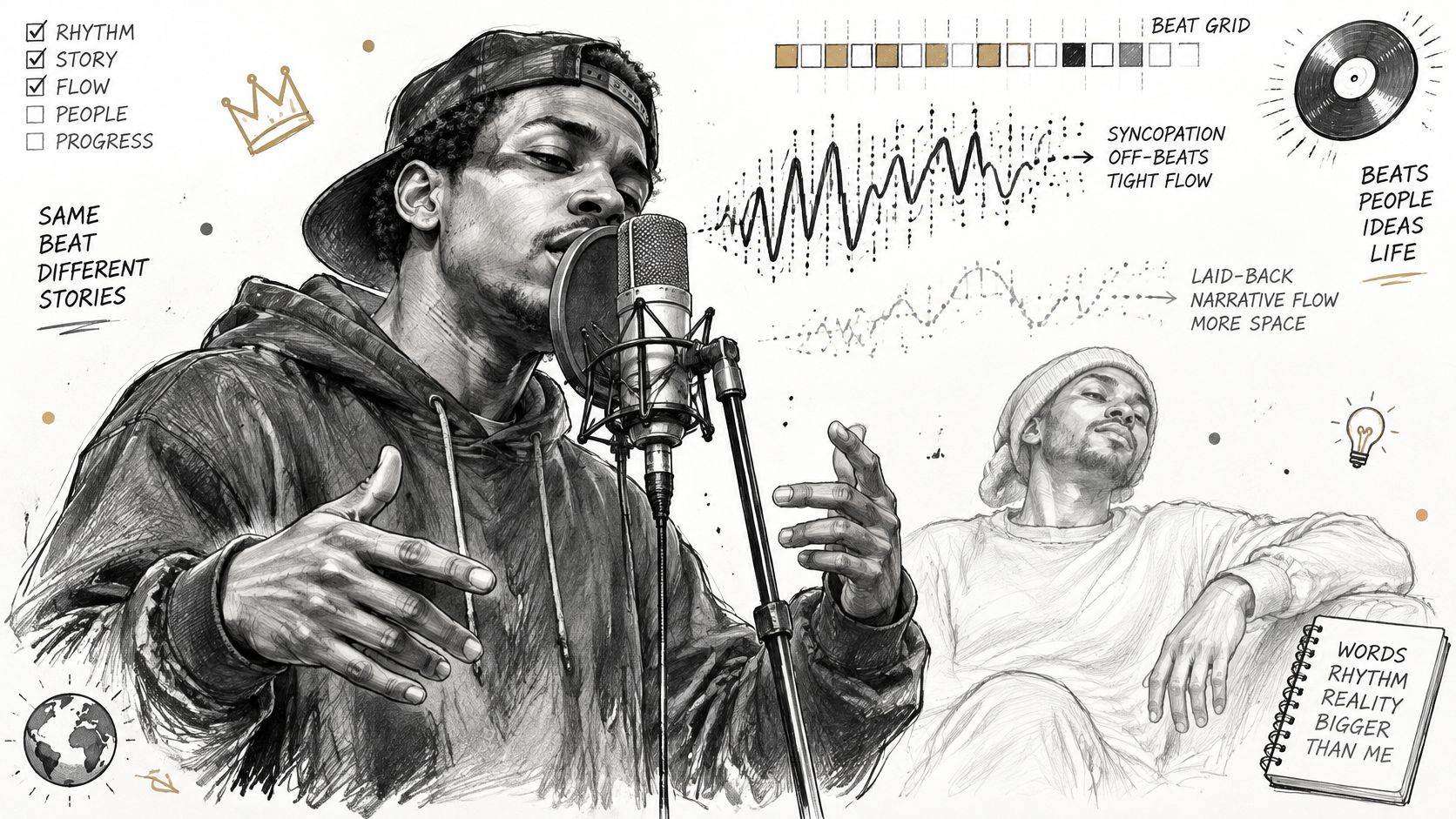
This recording sketch offers a visual prompt for listening to the performer and arrangement separately.
Musical prosody concerns the relationship between speech rhythm, syllable quantity, accentuation, and musical timing. The Speech Prosody paper by Migliore and colleagues provides a framework for understanding how linguistic delivery aligns with music.
Vocal roles and what each signals about style
| Vocal role | Typical delivery | What it signals |
|---|---|---|
| Lead verse | Rapped or spoken against the main pulse | The principal vocal approach |
| Sung hook | Sustained or clearly pitched singing | Melodic rap or R&B influence |
| Ad-lib | Short shouted or whispered fills | Supporting energy, often associated with trap and Southern approaches |
| Shouted group vocal | Voices chanting together | Crunk or party-oriented participation |
| Doubled phrase | A repeated line stacked with a slight timing offset | Deliberately layered production |
| Whispered texture | Breathy, low-volume delivery | Atmospheric or experimental treatment |
Tag the function before the genre
Give each layer its own description. A lead verse might be tightly aligned to the beat, while the hook sustains pitches and the ad-libs answer from behind the main phrase.
Check syllable alignment, pitch contour, accent strength, and layer timing. Pitch contour means the shape of the voice as it rises and falls; layer timing means how one take aligns with another. These observations tell an editor more than a tag that merely says rap vocals.
Use the embedded video as another opportunity to separate what the main voice does from what any supporting layers do.
Say a trap arrangement contains a sung hook and doubled ad-libs. The hook supports a melodic qualifier, but the doubled phrases describe a production technique, not a separate genre. Keeping those distinctions clear helps with editing, remix preparation, and vocal-layer cataloguing.
Rap Beyond the U.S. Canon
A track pairs an Afrobeats-influenced rhythmic foundation with rapped verses. Call it trap because you hear electronic bass, and you've missed the arrangement's main rhythmic character. A Latin-influenced recording raises the same problem: Spanish-language delivery tells you the language being spoken, while the drums still need their own description.
Rap and R&B rank among the most-streamed genres in the U.S., yet audience size says nothing about regional identity. A guide centered only on New York, Atlanta, Chicago, and their adaptations leaves you without vocabulary for African, Latin, Asian, and other regional scenes. Lumping every non-U.S. scene into one international rap category would hide the differences this guide teaches you to hear. The workable approach keeps the same careful listening you applied to U.S. styles and adds local context.
Start with language and musical context
Four questions sort most regional recordings:
- Language and pronunciation: Where do syllables lengthen, stress fall, and phrases naturally end? A flow you can't understand word-for-word can still be rhythmically dense.
- Local rhythmic foundations: Does the backing keep a recognizable local dance pattern underneath rap delivery?
- Scene history: Check artist credits, local interviews, and release descriptions. A borrowed sound doesn't make an artist a member of the scene that developed it.
- Vocal practice: Compare speech-like passages, chants, and pitched phrases. English-language rap isn't the default model for how a voice should behave.
Avoid the shortcut: Language tells you something important about a recording, but it doesn't identify its complete musical style.
Treat regional origin as context when it's documented, then describe the audible approach. Inferring an artist's location from pronunciation alone misfires, and labeling an entire continent as one scene erases the distinctions you just learned to catch. A precise description acknowledges local identity and outside influence without making either disappear.
Labeling Any Track, Hybrids Included
A useful genre label summarizes evidence. It shouldn't force every part of a recording into the same category.
Accio's music-trend overview describes cross-genre blending involving rap, pop, Afrobeats, electronic music, and Latin sounds, alongside phonk's movement from Memphis-rap and lo-fi influences toward darker internet and gaming contexts. That makes origin, adaptation, and present sound separate questions.
Build the description from audible evidence
- Tempo and drum programming. Establish the pulse, then describe the percussion: sampled break, sparse programmed hits, rapid hi-hat subdivisions, or chant-supporting dance rhythm.
- Bass treatment. Distinguish a moving funk-style line from sustained sub-bass, clipped low-end hits, or pitch slides. Describe what the bass does rather than calling it heavy.
- Delivery placement. Identify whether the main verse sits tightly on the grid, trails the pulse, or repeatedly shifts its accents.
- Vocal roles. Separate the lead, hook, responses, and textures. A change in hook delivery may justify a qualifier without redefining the entire beat.
- Lyrical themes. Note storytelling, social argument, humor, celebration, or confrontation. Subject matter can support a label, but it doesn't determine the drum style.
- Language and regional markers. Check documented scene connections against the vocal and production evidence.
- Intended setting. Consider whether the arrangement emphasizes crowd participation, dancing, close listening, or atmospheric background use. Treat this as supporting context.
Start with the most distinctive cluster of traits, check its historical fit, and add a hybrid qualifier only when another influence is clearly audible. Chicago drill and later drill adaptations shouldn't become interchangeable merely because they share bass techniques.
Test a label instead of collecting adjectives
Say a track combines bass slides, triplet-based phrasing, dark themes, and a cadence consistent with Chicago drill. Drill is a reasonable working label, subject to checking its scene context. If the chorus introduces sustained singing, drill with melodic hooks is more informative than replacing the whole description with melodic rap.
Production trends can help explain why new combinations circulate. According to Splice and MIDiA, reported by Music Business Worldwide, pluggnb sample-pack downloads increased 342.8% year over year in 2024 to 699,987. That's a measure of sample-pack activity, not proof that every track using those sounds belongs to pluggnb.
For a difficult vocal comparison, our process at Isolate Audio lets you describe the target in plain English, such as a sung hook or piano melody. Separating the hook can help you hear its pitch movement without mistaking the accompanying melody for vocal melody.
Choose a track, complete the checklist, and write one line containing a primary style plus only the qualifiers you can defend.
Isolate Audio lets you describe and separate a sound from a recording so you can study a rap verse, sung hook, or backing element more closely. Visit Isolate Audio, upload a track you're analyzing, and isolate the layer that will help you confirm its style.