Bird Song of a Robin: How to Identify and Isolate It
Which robin sang that phrase, and why does it sound different tonight than it did in spring?
Most listening guides answer with a single melody, as if every robin carries the same tune wherever you go. That doesn't survive contact with a real recording. A robin's song is a structured acoustic signal whose measurable features move with noise, light and season, and the bird singing in a British garden belongs to a different species from the one on a New England lawn.
Get those two facts straight, and everything else in the listening gets easier: where the energy sits on a spectrogram, when the singing peaks, how a loud habitat bends the song upward, and how to lift one bird's phrases out of a field recording without hollowing them out.
What a Robin's Song Sounds Like
What makes a robin's song recognisable: its pitch, its rhythm, or the time of day you hear it? The answer depends first on which robin is singing. The European and American robins are unrelated birds, and their songs can be compared through measurable features rather than treated as one fixed melody.
Two birds share the name
The European robin (Erithacus rubecula) is the small, round, orange-faced bird common in British and Irish gardens, a chat related to nightingales. The American robin (Turdus migratorius) is a larger thrush with a rusty breast, known for singing low and sweetly at first light. Their different phrase patterns, pitch ranges and singing times offer clues a listener can check by ear and on a spectrogram.
| Song feature | European robin | American robin |
|---|---|---|
| Frequency information | Energy sits above a minimum of about 2 kHz in quiet places | 2–4 kHz peak sound-pressure band |
| Phrase structure | Repeated phrases of short syllables | Repeated, phrase-based delivery |
| Peak singing time | Dawn, male-led in breeding season | Dawn peak with little midday activity |
Listen for rhythm first. Robin songs arrive in clusters of phrases with small gaps, rather than as one continuous stream. Then consider pitch: the American robin's reported 2–4 kHz peak band sits in a relatively low part of a spectrogram, where human speech also occupies space. That helps explain its mellow quality, though a shared frequency band alone cannot identify a bird.
Listen in this order: phrase rhythm, pitch band, then time of day. Treat these as clues, not a single definitive test: species, season and habitat can all affect what reaches the microphone.
A repeated, phrase-based warble from a garden hedge or woodland edge at dawn is consistent with a robin. A bird singing from an open treetop at midday is a reason to check the identification again, not proof of a different species. Light and surrounding noise can also change what a recording captures, so compare several features rather than relying on one sound.
For recording work, first describe the target in plain English, such as “robin song” or “short, repeated bird phrases.” Clear descriptions help make later isolation steps repeatable. Learn how to describe a sound before choosing what to separate from the recording.
Why Robins Sound Different Through the Year
A robin doesn't hold one tune steady for twelve months. The loud, confident song that many listeners recognise is breeding-season full song, produced mainly by males from a song post, doing the work of territory defence and mate attraction. It's the version that ends up on recordings and in field guides, and it's the one listeners carry in their heads as "the robin".
The rest of the year sounds different because the job is different.
Outside the breeding season, both sexes of the European robin can sing to defend feeding territories, and females also produce soft song, a quiet vocalisation that rarely carries far (BMC Neuroscience). A quiet autumn performance isn't a bird failing at spring song. It's a bird doing a smaller, more local job with the same instrument.
Think of full song as a concert from a bandstand and autumn soft song as two neighbours talking over a fence. Different volume, different audience, same need to be heard by the right party.
Recordists sometimes treat autumn vocalisations as unusable noise. The opposite holds. A study of 25 non-breeding European robins recorded across six sites in autumn 2022 analysed the song as a measurable, structured acoustic signal rather than an undifferentiated melody (PMC study of robin song and noise). Those autumn recordings were detailed enough to show exactly how background noise reshapes the song.
Season tells you which song you're hearing. Loud, sustained, dawn-only singing points to breeding context. Quiet, sporadic, daytime singing points to territory defence in autumn or winter.
Keep song and calls separate in your notes too. Song is the sustained, patterned output tied to territory and mating. Calls are short contact or alarm sounds, single notes with a job to do in the moment. A recording full of sharp ticks and chips is a bird communicating, not a bird singing, and it belongs in a different folder.
How Background Noise Reshapes the Song
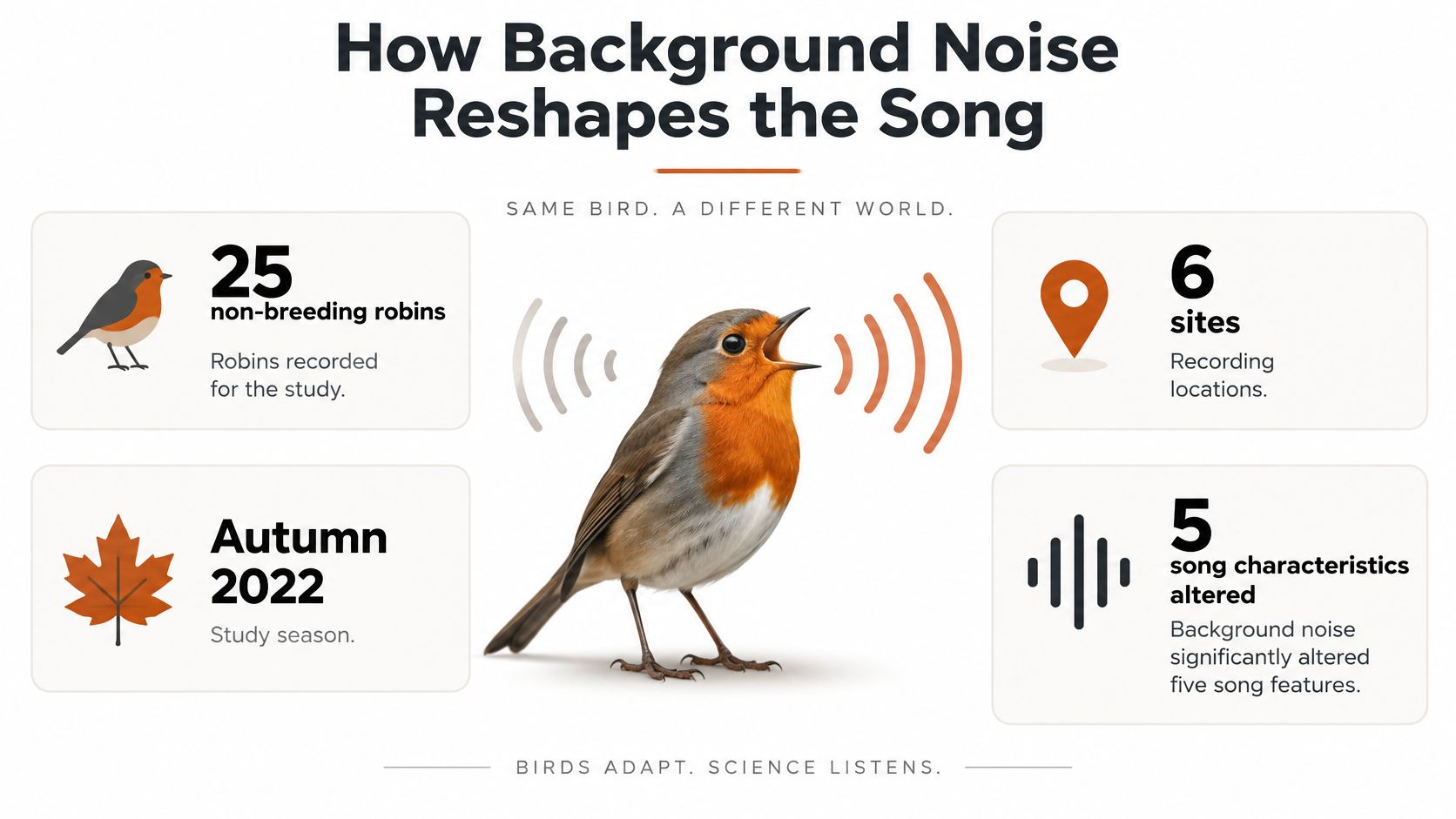
A robin's song is not a fixed melody. Its measurable features can shift with the noise around the bird, so the same species may sound different in a quiet habitat and a noisy one.
| Background noise | Minimum frequency | Syllables per phrase and syllable length |
|---|---|---|
| Quietest sites (about 28 dB) | about 2 kHz | more syllables per phrase, shorter syllables |
| Noisiest sites (up to 83 dB) | about 3 kHz | fewer syllables per phrase, longer syllables |
The comparison comes from recordings of European robins across sites with different background-noise levels (An infographic detailing how background noise in the environment alters the singing patterns of European robins.). Traffic, wind, water and machinery can mask lower-pitched sound. In noisier places, robins sang with a higher minimum frequency and used fewer, longer syllables. Raising the lowest part of a phrase is like moving a message above a band of static: it may be easier to hear without changing the whole song.
The study found a significant change in syllable number per phrase, while phrase duration shifted in the same direction. For recordings, this means a city-park robin and a robin on a quiet moor may be the same species expressing its song differently. The pattern is evidence of a relationship between noise and song features, not a guarantee that every bird responds in exactly the same way.
A separate study indexed in 2025 also examines how noise relates to European robin song (PubMed record of the 2025 study). The evidence presented here does not establish a specific recording location or support a more detailed claim about its findings, so treat it as a further reference rather than a basis for a precise comparison.
A shift of roughly 1 kHz in minimum frequency, or a visible change in phrase structure, can reflect the habitat rather than a different species or individual. Check the recording context before labelling an unusual song. If noise masks the phrase, background noise removal from audio can help you hear it more clearly. In Isolate Audio, describe the sound you want to isolate in plain English, such as “bird song,” then compare the result with the original to make sure the phrase rhythm remains clear.
Confirm Species, Season and Timing First
What does a robin's song tell you about the bird, and what might it reveal about the conditions around it? A recording needs context before its sound can be compared with a reference. A species label based on song alone can carry an error into every later step.
First separate the European robin from the American robin. They are different species, and their songs should not be treated as interchangeable. Note the continent and recording location; that context can help settle the identification before you inspect the finer details of a phrase.
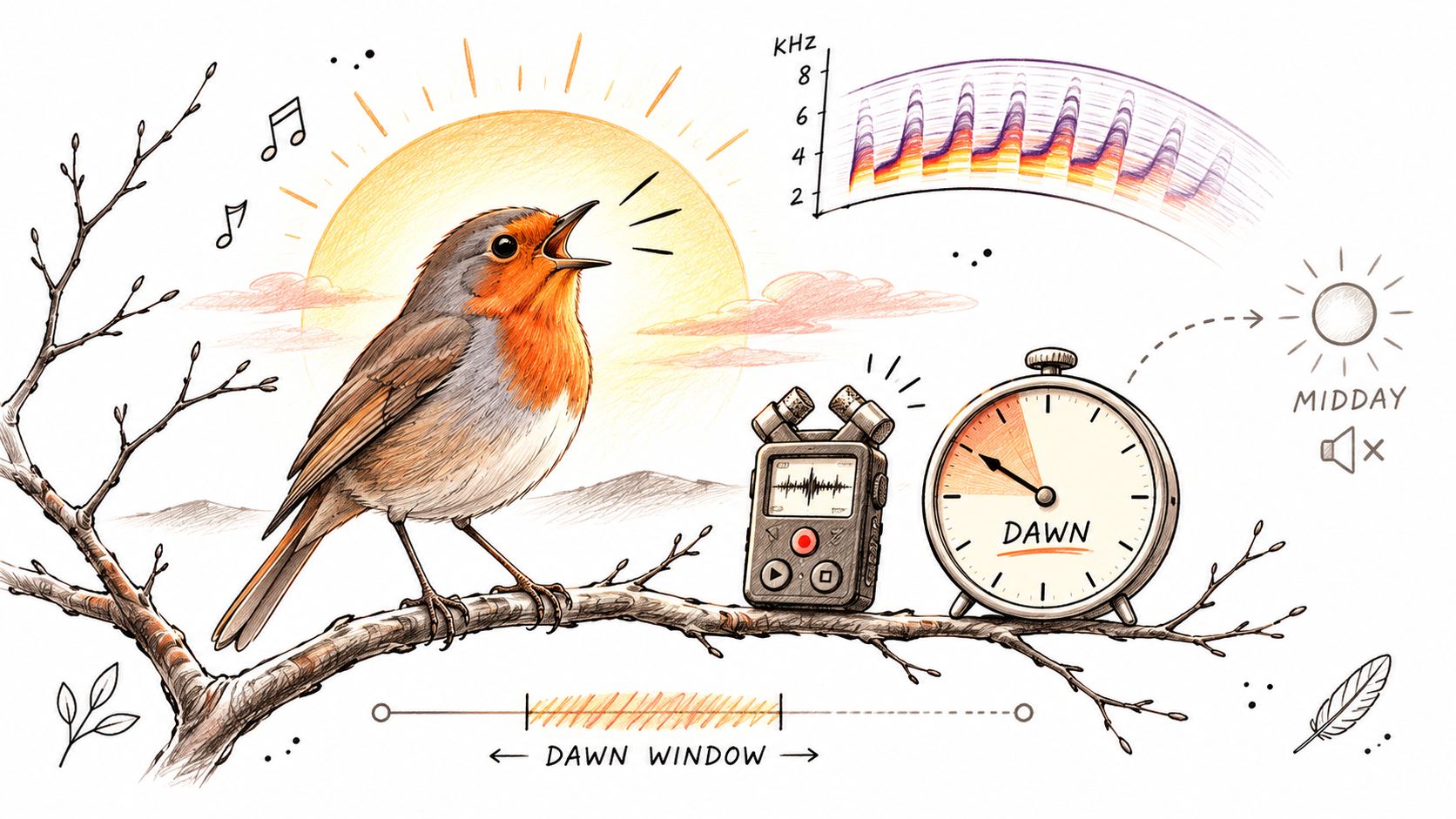
Then consider when the bird was singing. Male American robins show a pronounced dawn peak in singing, with little activity around midday. In one behavioral study, synchronous female emergence from roosts at dawn coincided with synchronous cessation of male song. Less synchronized daytime and evening nest visits corresponded with more scattered song periods (Wilson Journal of Ornithology study). Song therefore reflects territorial and reproductive context as well as the time of day. Record the timestamp relative to sunrise, not just the clock.
Artificial light can shift that timing. In Schuylkill Haven, Pennsylvania, observers recorded a robin singing at 1:11 a.m. Eastern Standard Time on 16 April 2002, 155 minutes before the end of true night. During the same seasonal period in 2003, robins began their morning chorus an average of 49 minutes earlier, starting during true night on 32% of sampled days (The Condor). A dawn recording near artificial light may therefore occur well before sunrise, so note both the clock time and light conditions.
Use four checks to label a file:
- Species. Record whether it is European or American, and include the location.
- Season and vocalisation type. Note whether the recording contains breeding song, autumn or winter territory song, soft song, or a call. These vocalisations can produce different spectrogram shapes.
- Timing. Log the date, clock time, minutes before or after sunrise, and civil twilight. A song at 1 a.m. in a lit car park has a different context from one at 5 a.m. in a dark wood.
- Conditions. Note habitat, weather, and approximate background noise. Noise alone can move minimum frequency and phrase length. For Florida waterbird habitat context, where to paddle among Florida's waterbirds is a paddling guide, not a robin-identification resource.
When the checks point in different directions, preserve that uncertainty in the filename rather than forcing a species label. This keeps the recording useful for later comparison without treating a shifted song as a different bird.
How to Isolate a Robin Song from a Recording
Isolation is a decision-making job before it's a filtering job. The American robin's song is acoustically distinctive for its relatively low dominant frequency, with peak sound pressure measured around 2–4 kHz, lower than the 4–8 kHz range reported for several other bird species (acoustic profile of the American robin's song). That low profile puts robin energy in the same band as human speech fundamentals and plenty of environmental sound, so a crude high-frequency filter cleans nothing and costs you the song.
Work in this order instead.
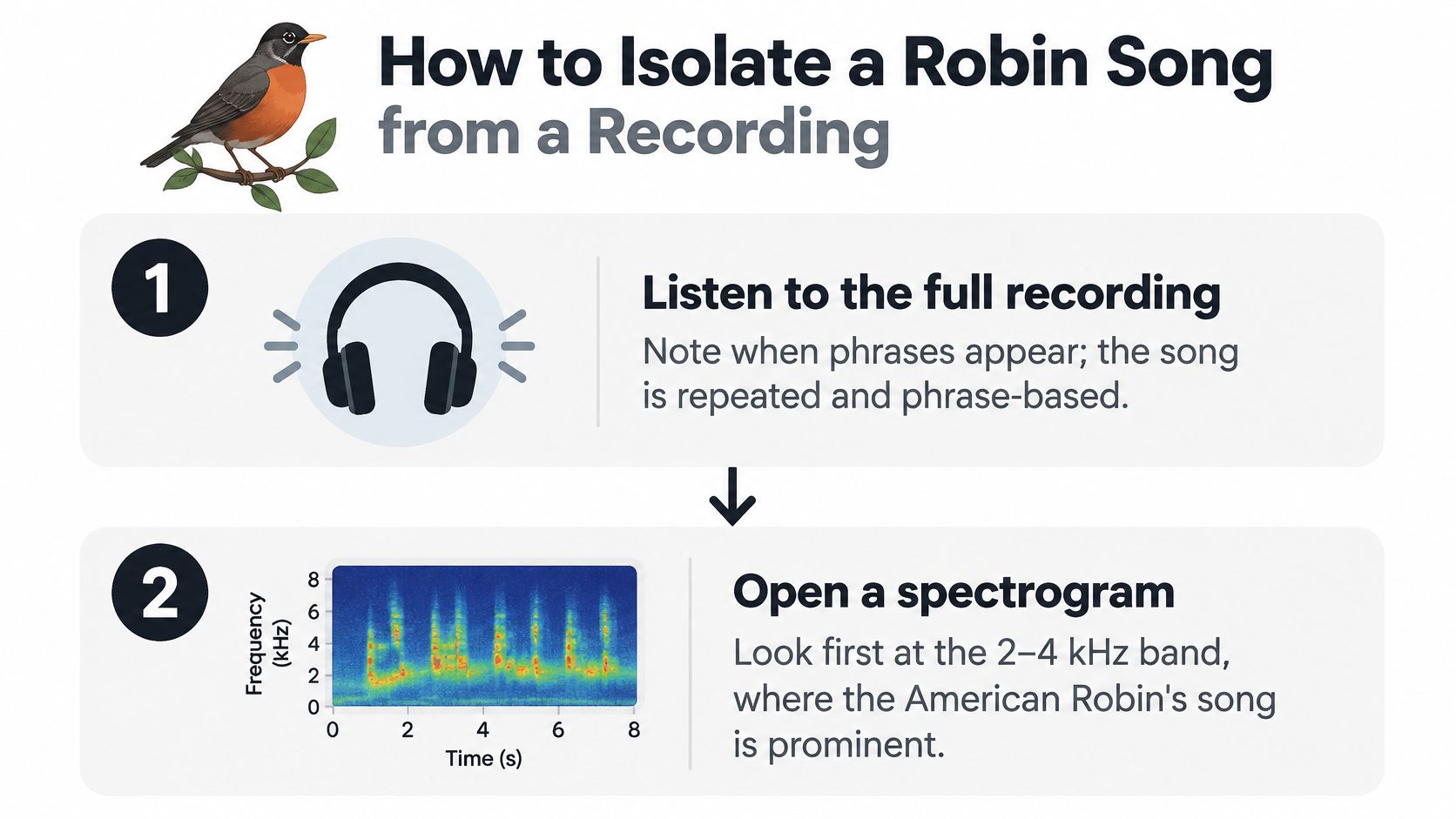
- Listen through the whole file first. Note the timestamps where each phrase group begins and ends. The repeated, phrase-based delivery gives you natural anchors, and a single pass at speed will miss the quieter phrases you want. If the audio arrives inside a video file, pull it out first; extracting MP3 and WAV from MP4 covers the command-line route cleanly.
- Open the spectrogram and start with the 2–4 kHz band. That's where the American robin's energy peaks, so it's where the phrase shapes are easiest to see. Read the whole display before you narrow anything, because the timing pattern is part of the signal.
- Skip the narrow band-pass filter as your main tool. It removes song structure along with the noise, and it keeps unrelated broadband sound that happens to sit in the same band. The common mistake here is treating the robin as a single stationary tone.
- Retain harmonic and temporal information. The song moves in pitch and repeats in rhythm, and both carry identification value. A flattened, harmonic-free clip is harder to defend than one with some room ambience left in it.
- Separate by time and frequency together. Select the regions where phrases sit rather than cutting whole frequency bands. This is how you drop wind, insects and traffic rumble that overlap the song without deleting the song itself.
- Describe the target in plain English. You describe the sound to isolate in plain English, such as "Piano melody" or "crowd noise", and for this job you'd type something like "robin song" or "bird singing". The tool returns the isolated element and the remainder as separate files, which gives you both sides to compare; the guide to isolating a sound from audio walks through the workflow.
- Check the output against the original. Replay both and confirm the phrase rhythm is intact, then export with the date, time, location and noise conditions attached to the filename.
A self-check closes the job. If the phrases sound clipped at their edges, or the pitch band feels hollow in the middle, the isolation was too aggressive. Back off, keep more of the surround, and try again.
Reading the Isolated Song Against Reference Values
Measurement turns a clip into evidence. Run five checks before you decide what you have.
- Count phrases per burst. Note whether the phrases repeat in a clear rhythm or arrive in a scattered jumble. Rhythm broken into fragments usually means over-processing, not an unusual bird.
- Read the minimum frequency of the lowest clean phrase on the spectrogram and hold it against the reference points: about 2 kHz in quiet habitat, about 3 kHz at the noisiest sites.
- Check syllable shape. Short and numerous points one way, long and few the other, since noisier habitat favours fewer, longer syllables.
- Compare with your pre-isolation notes. A minimum frequency near 3 kHz from a loud roadside fits a robin adjusting to noise. A clip far outside the 2–4 kHz band, or one with no phrase structure at all, may be another species or an over-cleaned artefact.
- Log it or drop it. Record the measured minimum frequency, phrase count and noise level in your notes, and keep the clip only if its rhythm and pitch band pass those checks.
The aim is a reading you can defend to another listener, not a species call from one clip.
Isolate Audio takes the hardest step off your desk: upload a field recording, describe what you're after in plain English, and download the bird song of a robin as its own file alongside the untouched remainder. You get both outputs to compare, which is exactly what careful annotation of a robin recording requires. Visit Isolate Audio and try one of your own dawn recordings today.