How to Cover a Song: Rights, Recording and Release
You've picked a song, worked out the chords, and found a key that suits your voice. The recording feels achievable. What's less obvious is whether you can release that performance as an audio track, post a filmed version, or use a backing track extracted from the recording.
To cover a song without rebuilding the project later, treat it as separate deliverables: a new master recording and a properly licensed composition. Decide what you're changing and where you'll publish before you start tracking. Those decisions determine which permissions you need.
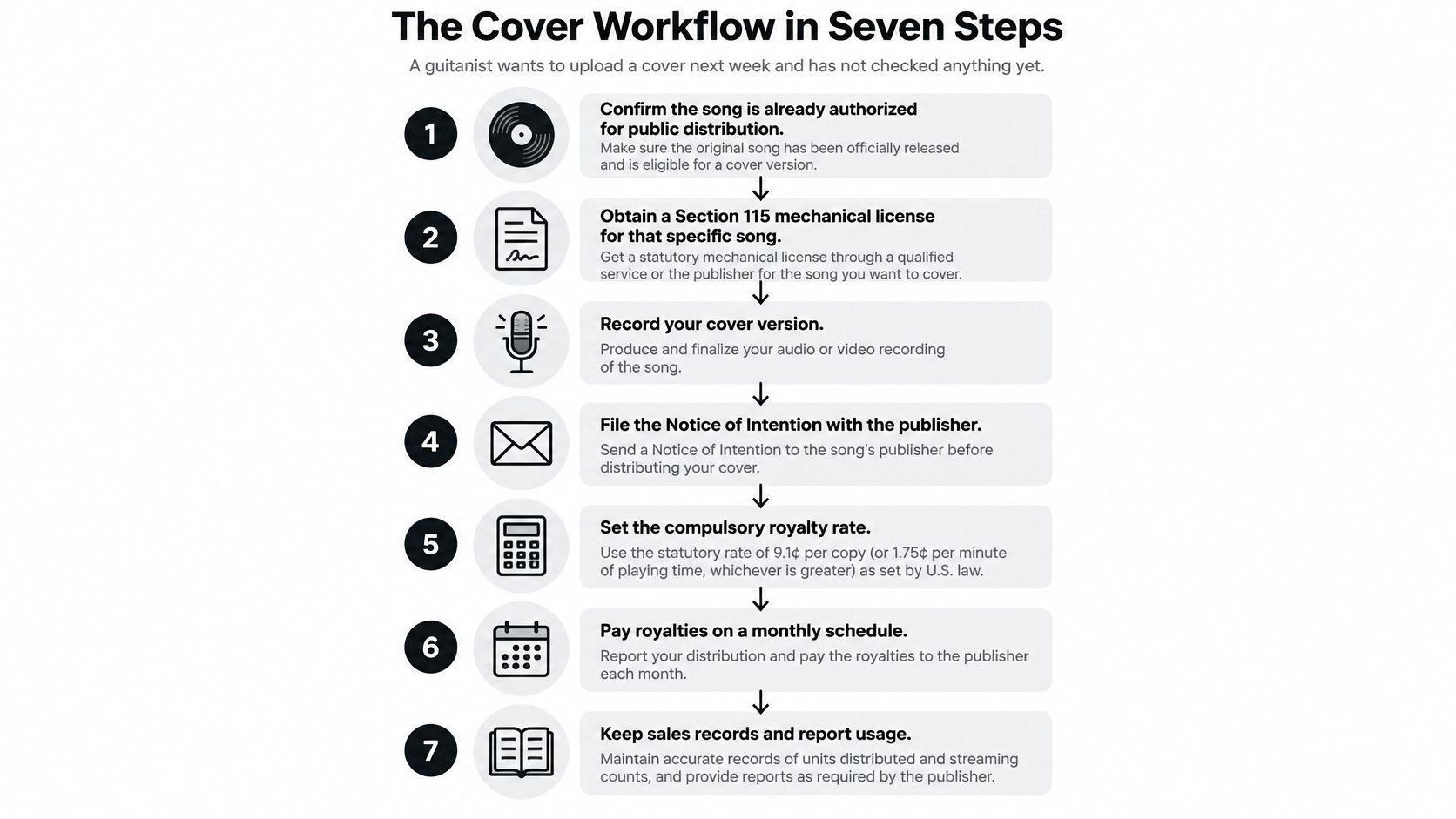
The Cover Workflow in Seven Steps
Say you're a guitarist planning to upload a cover next week, and you haven't checked anything yet. Don't start by booking the session or exporting a backing track. Start with the arrangement and release plan so you don't pay for a recording you can't use as intended.
- Confirm the song's release status. Check that the composition has already been authorized for public distribution, rather than relying on an unofficial upload.
- Settle the arrangement. Write down your proposed tempo, key, instruments, structure, and lyrics before choosing the licensing route.
- Secure composition clearance. Obtain the appropriate mechanical license or confirm the applicable platform licensing coverage before release.
- Record a new performance. Perform the parts yourself or use legally obtained material with permissions that expressly cover your intended use.
- Mix your own audio. Keep the original master, including extracted vocals or instruments, out of the release unless separately cleared.
- Document the contributors. Collect agreements, recording ownership details, and accurate songwriter and publisher metadata.
- Check the final release format. Prepare the audio upload, or secure the necessary synchronization permission before publishing video.
Use this visual as a licensing checkpoint, not a substitute for confirming your particular release's requirements.
Make approval a release requirement
Build your music distribution plan around an approval folder, not just an upload deadline. If several people handle production and delivery, Creators Toolbox's guide to chaining triggers, AI steps and approvals offers a useful way to organize handoffs. Keep a human responsible for checking the actual permissions.
First checkpoint: Changing the lyrics changes the licensing question. Approve the arrangement before anyone orders licenses or commits to a release date.
Why a Cover Needs Two Separate Permissions
The composition is the song's music and lyrics. The sound recording, often called the master, is a particular recorded performance. Songwriters and publishers control the former; the recording artist, label, or another contracted owner controls the latter.
The distinction has a practical consequence: recording your own performance avoids using someone else's master, but it doesn't remove the songwriter's rights. The mechanical-license history and framework explains how the U.S. compulsory system allows eligible reproductions of previously released compositions while preserving the distinction between the song and its recording.
The heading doesn't mean every cover requires permission from the original recording owner. If every audible part is newly performed, you generally aren't licensing that original master. You're clearing the composition and establishing who owns your new recording.
Permission needed by release type
| Release type | Permission needed | Key point |
|---|---|---|
| Audio-only download or stream of your new recording | Mechanical license for the composition | Compulsory route in the U.S., handled song by song |
| Audio-only release using the original artist's master | Permission for the master plus the composition | Using original audio needs both clearances |
| Music video, lyric video or visualizer | Synchronization license from the composition owner | The mechanical license does not cover visuals |
| Livestream or podcast placement of the song | Usually separate permission from the publisher unless applicable platform licensing covers it | Check platform terms and territory |
| Private practice file, not published | Generally no release clearance while kept private | Private use isn't blanket permission to copy or upload material; sharing changes the assessment |
Synchronization means pairing the composition with visuals. Filming yourself singing doesn't turn that use into an audio-only release, and a static visualizer shouldn't be treated as a licensing workaround.
Livestreams and podcast placements also deserve their own review. Don't assume that permission for a downloadable single covers an archived performance, a podcast episode, or promotional clips.
Choose the release format before buying clearance. The permission should describe what you'll actually publish, not what you originally intended to publish.
AI processing doesn't erase these distinctions. LegesGPT's discussion of AI copyright is useful context when separating questions about generated material from rights in existing source material. For a cover, keep the operational question concrete: whose composition and whose recorded performance will the audience hear?
Which Arrangement Changes Keep Your Cover Safe
Cleaner audio separation can increase rights risk. It makes it easier to retain an original performance, imitate a distinctive arrangement, or mistake an extracted part for something you're free to release. Better isolation is a production capability, not permission.
The Soundverse guide to cover-song distribution distinguishes a new performance from changes that affect the underlying composition. Substantial lyrical or musical changes can require direct approval rather than fit a straightforward compulsory-license release.
Before tracking, choose the tempo and key. Decide which instrument carries the melody, sketch the chords and form, and write a change log against the released song. Make that document specific enough for a publisher to understand without opening your recording session.
Arrangement changes and their rights impact
| Change | Example | Rights impact |
|---|---|---|
| Tempo or key change | Slowing a ballad or moving it to a new key | Usually a production choice; the cover generally stays a cover |
| New instrumentation | Piano and strings instead of a full band | Usually a production choice when melody and lyrics remain intact |
| Structural edits | Dropping a verse or reordering the chorus | Gray area; check with the publisher before release |
| Lyric changes | Rewriting a verse or swapping words | Changes the composition; obtain direct publisher permission |
| Original master audio | Keeping the original vocal or drum track | Needs master permission and appropriate composition clearance |
A faithful cover offers a new performance of the song. An arrangement changes its musical presentation, although the extent of those changes matters. A remix manipulates recorded material; a sample incorporates some of that material into another recording.
Those labels aren't interchangeable. If you retain the original drummer's isolated performance, calling the result an acoustic cover won't make the retained recording disappear. Use a sample-clearance workflow when your plan includes original audio.
Test the source, not just the sound
Ask whether the listener hears your performance of the song or an original performer's contribution carried into your mix. That's a useful production check, not a legal test for every arrangement dispute.
Also ask whether you've changed the song's meaning, lyrics, or fundamental musical character. A familiar melody isn't proof that every alteration is permitted. Keep the change log and get uncertain edits approved before recording expensive replacement parts.
How to Clear the Mechanical License Before Release
For a U.S. release, make the licensing request match the actual song, formats, and distribution plan. The U.S. Copyright Office's compulsory-license rule describes the Section 115 framework as song-specific and subject to royalty accounting requirements.
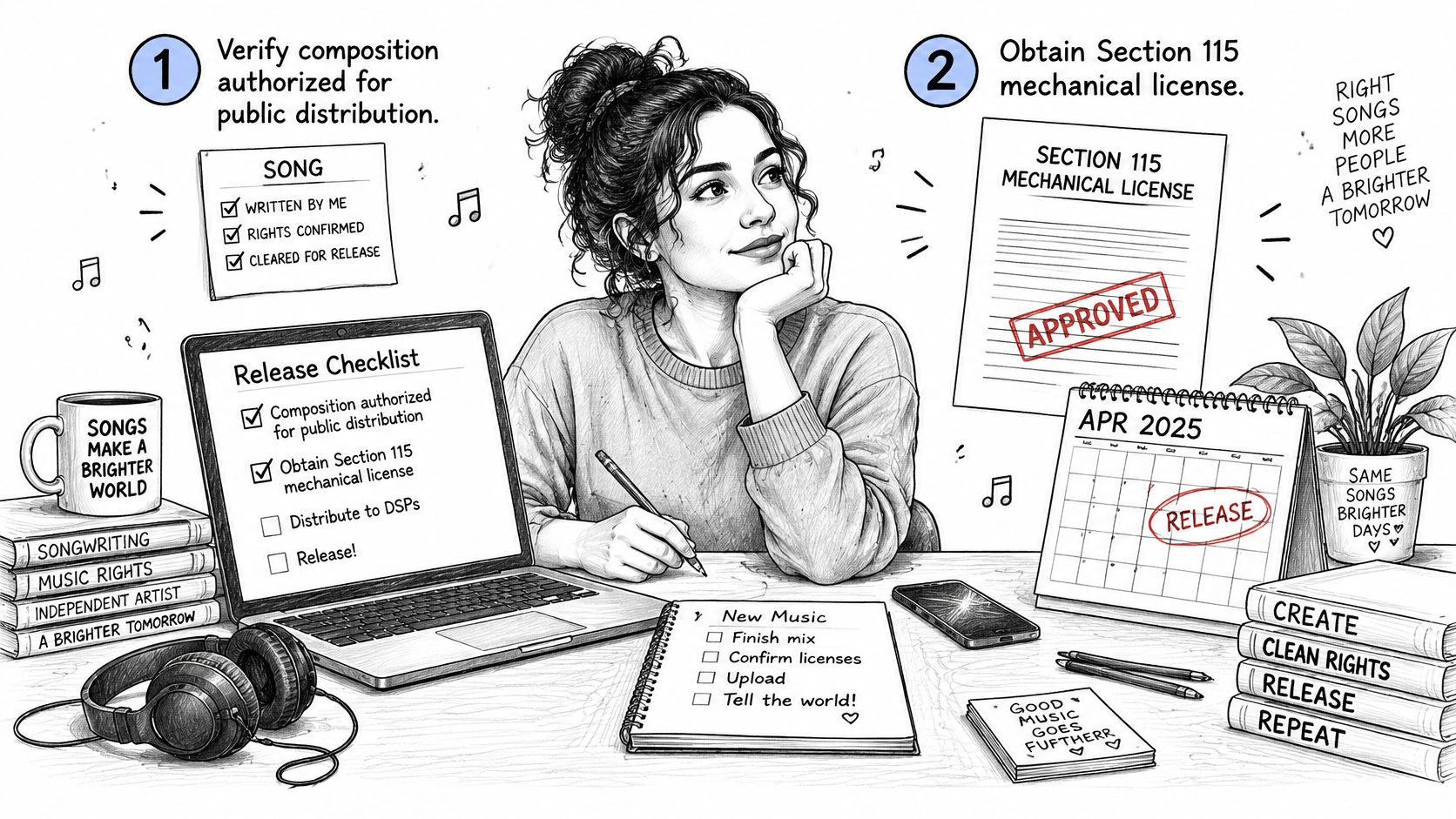
Keep a written release checklist beside the session plan so permissions don't become an afterthought.
Build the license file
- Verify the composition's eligibility. Confirm that it has already been authorized for public distribution. An unreleased demo or unauthorized leak isn't a reliable basis for proceeding.
- Obtain the appropriate mechanical authorization. Identify the exact composition and release formats, then use the applicable licensing route. Don't assume a license for another version or another song covers yours.
- Declare the intended quantities. Report physical copies or permanent downloads as required by the licensing route. Keep those quantities aligned with manufacturing orders and direct-store plans.
- Calculate and pay the applicable royalty. Use the current official schedule for the relevant use and period, not a remembered rate from a tutorial. Confirm payment and reporting obligations before committing to sales.
- Retain the complete record. Save the license, correspondence, statements, and payment confirmations together. Keep evidence of coverage for each format and territory you intend to supply.
For eligible interactive streaming and download uses, the Mechanical Licensing Collective administers the U.S. digital compulsory-license system. Establish which obligations the service or distributor handles and which remain yours; don't duplicate a platform's licensing unnecessarily, but don't assume every download channel is covered.
The Harry Fox Agency's Songfile service is another practical route to investigate for applicable cover releases. If your arrangement falls outside the compulsory pathway, contact the publisher directly with the change log and proposed uses.
Use the accompanying video as supplementary context while keeping your written permissions as the release record.
Catch the common clearance failures
- Upload approval isn't copyright approval. A distributor accepting your files doesn't establish that you hold the necessary rights.
- Master ownership isn't composition clearance. Owning your recording doesn't authorize distributing someone else's song.
- Territory and format limits matter. Check the actual grant rather than treating any license as worldwide, all-media permission.
- Artist identity isn't included. Composition clearance doesn't authorize implying endorsement through the original artist's name or likeness.
Finalize the arrangement before submitting the request. If you later rewrite a verse or materially alter the song's character, pause delivery and reassess the authorization instead of assuming the existing paperwork stretches to fit.
Record, Document and Verify Your Cover
Start with a legally obtained reference recording and confirm that your intended processing is permitted. Use it to study phrasing, chord movement, and the roles of each part, not as an undeclared source of release audio.
With Isolate Audio, drag and drop an audio or video file, describe the sound you want in plain English, such as piano melody or lead vocal, then download the separated tracks. Keep those files in a clearly marked reference-only folder outside the release session. Audio separation doesn't clear copyright.
Build a performance you can account for
Write your own parts from the arrangement sheet, then record them separately. Choose your own voicings, articulation, dynamics, and sounds rather than trying to conceal an imported performance. A convincing cover needs a coherent interpretation, not a nearly invisible copy of the reference.
For a guitar-led version, record a guide vocal and rhythm guitar first, then replace or refine each part deliberately. Check that the vocal tells the story before adding layers. Our guide to how songs are recorded provides context for organizing those production stages.
Keep the reference on a muted comparison track only if your session organization prevents accidental export. Better still, use a separate listening session. Check printed effects, bounced backing tracks, and sampler instruments for imported source audio before mastering.
The Harry Fox Agency overview from Tools4Music emphasizes the practical separation between a newly created master, composition licensing, contributor documentation, and accurate release metadata. Make that separation visible in your folders and agreements.
Assemble the documentation folder
- Contributor agreements. Record each musician's role, payment terms, permissions, and agreed credits. Use split sheets where contributions or ownership shares need documenting, without confusing performance credits with songwriting.
- Producer and master ownership. State who owns the recording and who can authorize delivery. Record who assigns and maintains the ISRC, which identifies the recording.
- Composition metadata. Save the exact title, writers, publishers, and available identifiers. Don't copy songwriter credits from an unreliable upload description.
- Performance evidence. Retain raw takes, dated session files, arrangement notes, and correspondence showing how the new recording was made.
- Release authorization. Store the approved territories, formats, quantities, licenses, statements, and payment records in the same release folder.
An ISRC isn't proof that you own everything in a recording. Likewise, a musician's permission to use their take doesn't resolve an unauthorized sample embedded in that take. Ask contributors to identify supplied loops, backing tracks, and third-party material before you approve their files.
Release safeguard: If nobody can explain where an audible part came from, don't include it in the delivery master.
Audit the destination before uploading
Check the exact asset: an audio single, filmed performance, lyric video, short-form clip, livestream archive, or podcast placement. Then check the territory, platform licensing terms, monetization conditions, and whether your documentation covers that specific use.
The Debut Room cover-licensing guide highlights territorial differences, including contexts where Australian online covers operate under existing arrangements while U.S. streaming may require separate reproduction coverage. Don't turn one platform's policy into a worldwide release rule.
If you're considering generated visuals, the Best AI Music Video Generators updates can help you evaluate production options. Keep that creative decision separate from the composition owner's permission to pair the song with visuals.
Before delivery, open the actual export and listen from start to finish. Match its filename, credits, duration, and version description to the approved release package, then resolve any unclear permission with the publisher or relevant rights organization. Don't release first and treat clearance as cleanup.
The separated practice track should stay a learning aid. Cleaner extraction makes copying easier, so keep a firm boundary between understanding the original performance and distributing your own.
Isolate Audio lets you isolate a sound by describing it in plain English, helping you study a vocal line or backing part while preparing your cover. Visit Isolate Audio to create a practice reference, then record your own performance and keep the extracted audio out of your release master.