
Easy Acostic Guitar Songs: 8 Beginner Picks for 2026
Three weeks of chord diagrams, and the guitar still sounds like a series of disconnected thuds. That's usually the moment a beginner stops, and it rarely has anything to do with talent or with the method they chose. The material was the problem: drills with no melody, no payoff, and nothing worth playing for another person.
Songs close that gap faster than any course. Gibson's 2026 learning report, based on 3,784 learners, states that 50% of new learners who played one of 75 famous songs did so within 2.5 hours of signing up (Gibson guitar practice statistics). Familiarity carries a lot of the load, because your ear corrects your fingers before your brain catches up.
The eight songs below aren't ranked by fame. Each one is picked for the single skill it trains hardest: chord switching, holding a groove, offbeat strumming, slow timing, or singing while you play. A two-chord song can still be the wrong choice if its rhythm fights you, and a four-chord song can be the right one if the changes land where your hand expects them. If your goal is singing rather than strumming, the same logic applies to these beginner-friendly tracks for karaoke creators.
1. Wonderwall (Oasis) for Clean Chord Switching
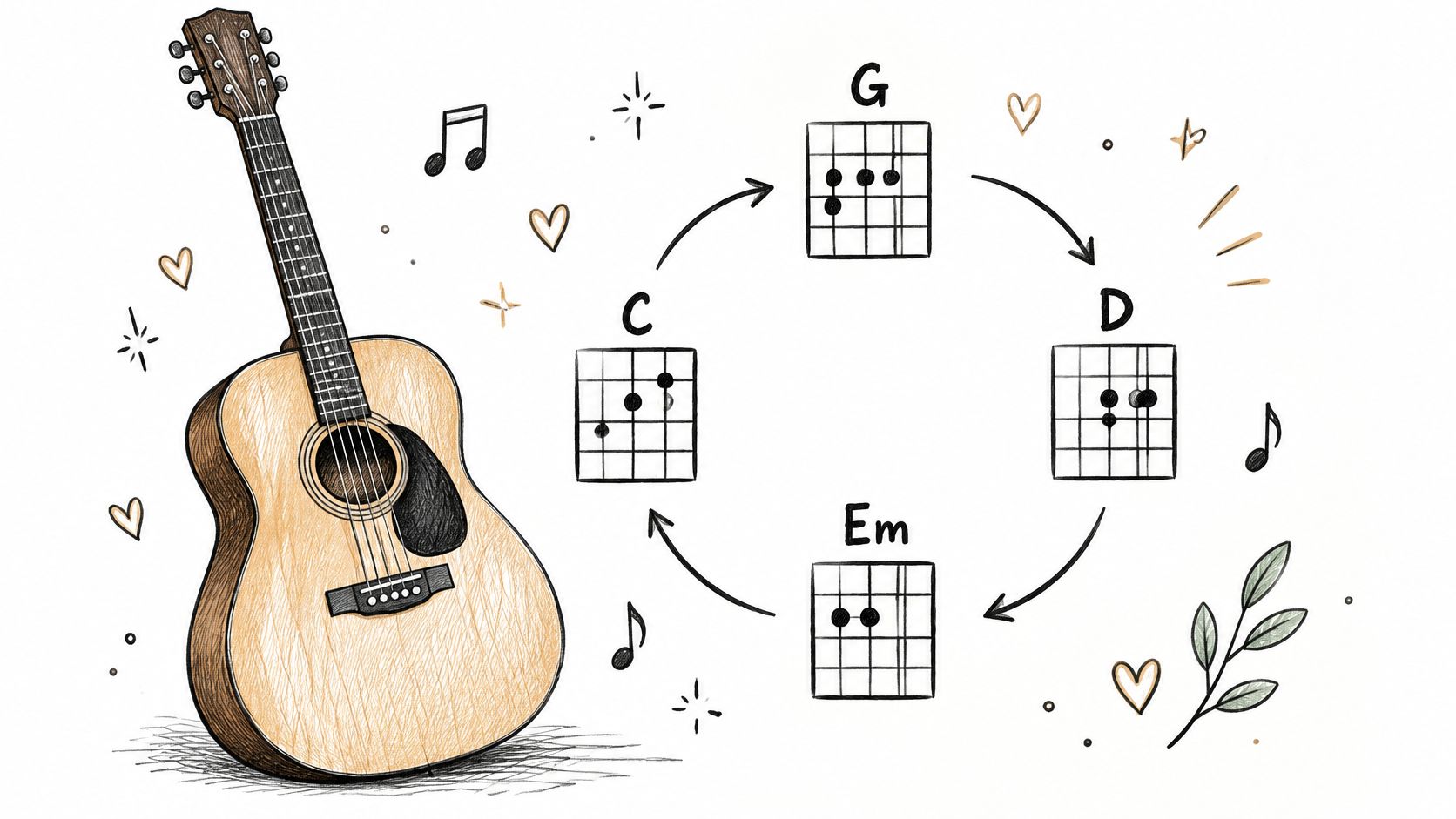
Released in 1995 on (What's the Story) Morning Glory?, "Wonderwall" hands you one chord loop and repeats it until your fretting hand settles down. That's why it works as a first song. You aren't absorbing new information every bar, so all of your attention goes to the change itself instead of splitting between shapes and structure.
The loop is the lesson. Plenty of beginners can form Em and G one at a time and still fumble them in sequence, because the skill was never the shape. It's the arrival.
Practical rule: Play the loop with a single downstroke per chord until the change lands without a pause, then add the strumming pattern. Two minutes of that loop beats any finger exercise as a warm-up.
The accuracy numbers back song-first practice. In Gibson's beginner-song dataset, beginners reached at least 80% note accuracy in roughly four out of five attempts across 44,403 beginner-song pairs covering 75 well-known songs. First-timers averaged 86.1% against 88.2% for intermediate players, which suggests the arrangement is doing more of the work than the player's formal experience level.
The friction point is the drone. Capo on the 2nd fret, with the 3rd fret of the B and high E strings held down for the whole song while the bass note shifts underneath. That drone is the sound of the record, and it's also why your index finger aches for the first week. Drop it for a few days, get the changes automatic, then add it back and hear the song appear.
If you want a wider shortlist at the same level, this guide to good acoustic guitar songs for beginners compares chords, tempos and capo use side by side.
2. A Horse with No Name (America) for Holding a Groove

Gear4music's 2024 guide to the best acoustic guitar songs calls "A Horse with No Name" the easiest acoustic song to play and notes that it uses just two chords. Both statements are true, and together they hide the actual difficulty. The shapes take twenty minutes. Four minutes of them takes a fortnight.
What the Right Hand Actually Learns
With almost no harmonic movement, the strumming hand has nowhere to hide. Every uneven stroke, every accidental speed-up, every bar that drifts a fraction fast is audible because there's no chord change to cover it. Play the song through once and you'll know more about your right arm than a month of drills will tell you.
The second chord intimidates people on paper. It's a D shape with an added sixth rather than a plain major or minor, and the movement between the two shapes is tiny, often a single finger sliding one fret. Learn it as a motion, not as a diagram.
- Keep the wrist loose: a tense arm accelerates on beat one of every bar.
- Change without stopping the hand: the strum keeps travelling while the fingers rearrange.
- Loop one bar for sixty seconds: if the bar is clean, the verse is clean, and if the bar wobbles, the verse will too.
The song punishes boredom more than clumsiness. Two chords for four minutes tempts anyone to rush, and rushing is the habit that ruins every later song you learn.
3. Don't Think Twice, It's All Right (Bob Dylan) for Folk Chord Movement
Released in 1963 on The Freewheelin' Bob Dylan, this is the song that teaches the movement folk players rely on for the rest of their lives. The folk revival is why beginner songbooks look the way they do. MusicRadar's history of the acoustic folk boom traces how Woody Guthrie's "This Land Is Your Land" in 1940, Dylan's "Blowin' in the Wind" in 1963, and the Kingston Trio's 1958 hit "Tom Dooley" established a repeatable, chord-based format that amateur musicians could copy.
The progression is short and the bass note moves underneath it. That's the step between strumming shapes and accompanying yourself, and it's the reason this song appears in so many method books.
Learn the changes with a plain strum first. Add the picking once your fretting hand has stopped thinking about where it's going.
Where it frustrates. Nearly everyone tries to fingerpick this in week one and produces a tangle, because the thumb wants to follow the fingers instead of holding its own steady bass. The G to C change with a moving bass note is where the whole thing collapses. Use simplified shapes, get the song recognizable, then upgrade the voicings one at a time.
A worked example: take the first two bars and play them at half tempo against a metronome, stopping after each pass. Move on only when the bass note lands on the beat every single time. Fifteen minutes a day for a week is enough to hear the difference, and it's far more productive than one long session on a Sunday.
4. Riptide (Vance Joy) for Singing While You Play
Released in 2013 on Dream Your Life Away, "Riptide" is the song that gets beginners to open their mouths. The chords sit in a small, friendly set with a capo on the first fret to match the recording, and the vocal line follows the melody closely enough that a wrong note is obvious to you before it's obvious to anyone else.
The Skill Is Coordination, Not Chords
Singing and strumming compete for the same sense of timing. Most players can do one or the other and fall apart doing both, and this song is forgiving enough to practice the split. Strum the pattern while humming the melody first, then add words one line at a time. Don't attempt the whole verse on day one.
Where it frustrates. The muted percussive strum and the quicker changes in the pre-chorus. If the wall is physical rather than rhythmic, such as a barre chord or a wide stretch, academic work on accessible guitar playing treats assistive chord helpers and open tunings as established ways to reduce physical and instructional barriers rather than as shortcuts to be ashamed of.
A slowed backing track built from the original recording makes the change points audible, and there's a practical walkthrough on building a backing track for guitar practice that covers looping a chorus and dropping the reference part as you improve.
5. Knockin' on Heaven's Door (Bob Dylan) for Slow Timing
Written by Bob Dylan for the 1973 film Pat Garrett & Billy the Kid, this is the song I hand to players whose chords are clean and whose rhythm isn't. The progression is four shapes in a slow loop, and the tempo is slow enough that every hesitation shows up in the open.
That's the entire point. Beginners rush because a gap in the sound feels like a mistake, so they compress the beat to fill it. This song won't let you.
Slow is a skill. Playing it cleanly at 60 BPM is harder than playing it badly at 100, and it repairs more habits than speed ever will.
Where it frustrates. The verse alternates between two chords at the end of each line, and the change back to the home chord is where hands hesitate. Set a metronome at 60 to 70 BPM, count out loud, and accept ten minutes of boredom. The lyric-driven arrangement also tempts singers to push volume to cover a late change, which makes the whole performance louder and no more in time.
A worked session looks like this. Two minutes on the G to D change with no strumming at all, three minutes of the verse loop against the metronome, then the entire song once, recorded on your phone. Listen back for the bar where you sped up, because that bar is tomorrow's warm-up.
6. Good Riddance (Time of Your Life) (Green Day) for Right-Hand Accuracy

Released in 1997 on Nimrod, this is the song for players whose strumming is fine and whose picking isn't. The intro is played as individual notes on the top strings rather than as full chords, so your right hand has to place each note instead of sweeping through all six strings.
Separate the Hands
The intro is where the teaching happens. Then the song opens into an ordinary strum, which means one piece gives you two techniques and a clear marker of progress between them.
- Intro first, strum later: pick the top strings and let the bass notes ring instead of strumming through them.
- Transition pairs on their own: C to D and G to Em, played without rhythm until they're clean.
- Ten clean repetitions: four bars at half speed, stop, reset, repeat.
Where it frustrates. The intro invites strumming, and strumming it hides the mistakes while destroying the part. The second trap is the transition pair, which sounds fine in isolation and falls apart at tempo.
A worked example: four bars of the intro at half speed, then stop and reset before trying again. Ten tidy repetitions are worth more than one untidy run of the full song. Players who suspect their hands are the problem should also check the setup on the guitar, because lighter strings and lower action often buy more accuracy than another month of practice on an instrument that fights back.
7. Three Little Birds (Bob Marley & The Wailers) for Offbeat Strumming
Featured on 1977's Exodus, this song has three chords and a strum that lands where a beginner's hand doesn't expect it. The chord work takes an afternoon. The rhythm takes a week, and that's exactly why it belongs on a list organized by skill rather than by popularity.
Here's the strumming pattern to work from.
Most easy acoustic guitar songs lists rank by chord count, and that's the gap. Chambers Music Studio's beginner song roundup points out that existing lists rarely explain whether a player can hold a steady beat, handle syncopation, or coordinate strumming with chord changes, and that a two-chord song with unfamiliar rhythm can be harder than a four-chord song with a straight pulse.
Count Before You Strum
The offbeat is felt, not guessed. Build it in stages:
- Count out loud: "1 and 2 and 3 and 4 and" for a full verse before touching the strings.
- Strum the "and" only: muted strings are fine while the placement locks in.
- Add the downstrokes back: once the offbeat lands without effort, the full pattern assembles quickly.
Where it frustrates. The reggae feel fights anyone raised on downstroke folk. Play it with a straight strum first to lock the chords, then rebuild the rhythm from the count. Trying to learn both at once is the reason people give up on this song and decide they "can't do rhythm".
8. Stand By Me (Ben E. King) for a Chord Loop That Sings
Released as a single in 1961 and written by Ben E. King with Jerry Leiber and Mike Stoller, this is the song that turns a beginner into an accompanist. The loop is familiar, the groove is steady, and the bass line underneath teaches a lesson most beginners miss. Chords have a bottom, and the bottom is what carries the song.
Play the Bass, Then the Chord
Split the part in three passes:
- Pass one: play only the lowest note of each chord.
- Pass two: add the rest of the chord on top of that bass note.
- Pass three: play the full loop with a metronome clicking on beats two and four.
Where it frustrates. The change from the home chord to the relative minor wants to arrive early, and strumming with alternating down and up strokes can double the tempo. Record one verse and count the strokes. If you can't count them, they aren't even.
A worked example: loop the four-bar progression for five minutes at a slow tempo, then play the song once and listen for the bar where the loop drifts. That drift is the habit to fix, not the chord you fumbled.
When the loop feels solid, this collection of acoustic guitar love songs draws on much the same harmonic vocabulary, which makes it a natural next step.
How the eight easy acoustic songs compare for beginners
| Item | Core chords | Feel and tempo | Biggest beginner hurdle |
|---|---|---|---|
| Wonderwall (Oasis) | Em7, G, Dsus4, A7sus4 | Medium, steady down-up strumming | Keeping the strumming rhythm steady |
| A Horse with No Name (America) | Em7, D6add9 | Relaxed, repetitive groove | Matching the original chord voicings |
| Don't Think Twice, It's All Right (Bob Dylan) | G, C, D, Em | Slow, reflective; strummed or fingerpicked | Imitating Dylan's vocal phrasing |
| Riptide (Vance Joy) | Am, G, C, F | Bright, upbeat, driving strumming | Keeping the strum consistent, especially with F |
| Knockin' on Heaven's Door (Bob Dylan) | G, D, Am, C | Slow, steady strumming or picking | Maintaining even timing |
| Good Riddance (Time of Your Life) (Green Day) | G, D, Em, C | Gentle, reflective; arpeggiated or strummed | Making quick chord changes at moderate tempo |
| Three Little Birds (Bob Marley & The Wailers) | A, D, E | Relaxed reggae groove with offbeat strumming | Getting comfortable with the offbeat rhythm |
| Stand By Me (Ben E. King) | G, Em, C, D | Steady, mid-tempo groove | Keeping the repeating strumming pattern engaging |
Pick One Song and Play It Through Tonight
Match the song to the weakness, not to the playlist. Chord switching belongs to Wonderwall and Good Riddance. Steady groove belongs to A Horse with No Name. Offbeat rhythm belongs to Three Little Birds. Slow timing belongs to Knockin' on Heaven's Door. Singing while playing belongs to Riptide and Stand By Me, and folk chord movement belongs to Don't Think Twice. Pick the one that names your weakest habit and ignore the rest of the list for now.
Then do the boring part. Ten minutes at a slow tempo, the full strumming pattern only once the changes are clean, and the same song again tomorrow. Sampling eight songs teaches you eight openings and no endings.
Personalization isn't a luxury, either. In a controlled study of the FretMate tool, participants using adaptive, skill-level-customized guitar practice averaged six practice days per week and 45 minutes per session, while the control group averaged four days and 30 minutes, according to the ACM paper on adaptive guitar practice. The experimental group also reported higher satisfaction with their progress and greater enjoyment of the customized songs.
Build the Practice Track Before You Build the Speed
A recording teaches better than a chord chart, provided you can hear the part you're learning. Pulling the guitar, vocal or percussion out of a finished mix lets you play against the remainder at the original tempo, loop the bar that keeps tripping you, and remove the reference part once you no longer need it.
Test to apply: if you can play the loop along with the original recording, you can play it alone. If you can only play it alone, you've learned the shapes, not the song.
Isolate Audio is one option for that workflow: you describe the part you want in plain English, such as "acoustic rhythm guitar" or "backing vocals", and it returns that element plus the remainder as a practice track.
Whichever song you choose, play it through tonight, even badly. The version you can finish is worth more than the eight you can almost play, and finishing is the habit that keeps the guitar in your hands past the third week.
Hearing a part on its own is what turns a chord chart into a song you can play, and Isolate Audio is built for that job. Upload a track, describe what you want in plain English, such as "acoustic rhythm guitar" or "fingerpicked intro," and download the isolated element plus the remainder for play-along practice, with studio-grade or quick presets depending on the session. Start with your first pick from this list at Isolate Audio.