Film Sound Design: A Practical Guide from Script to Mix
The picture looks right, but the scene still feels strangely empty. You review the dailies and see a convincing performance, a beautifully lit room, and a camera move that lands exactly where it should. Yet the door doesn't feel heavy, the hallway doesn't feel deep, and the character's fear doesn't reach the audience. Often, the missing element isn't another visual detail. It's the sound architecture underneath the image.
Film sound design gives the audience information that the frame can't carry alone. It tells us how large a room is, whether someone is approaching from outside the image, and whether a familiar place has suddenly become unsafe. The work starts with decisions about story and continues through recording, editing, isolation, Foley, effects, and the final mix.
Why Sound Shapes the Story
A woman enters an empty house. The cut shows her opening the door, crossing the threshold, and looking toward the staircase, yet the scene feels neutral instead of tense. The production track carries a faint HVAC hum, room tone shifts between angles, and the door closes without weight. Nothing has failed outright. The sound gives the audience no clear point of view.
The solution begins with story, often before anyone records a footstep. In the script stage, decide what the audience should notice, fear, or misunderstand. Later, on the stage and in post-production, those decisions become perspective: exterior ambience recedes as the door shuts, a tight pocket of room tone follows the woman, and the air drops away when she looks upstairs. One floorboard creaks after she stops moving. Each choice works like a camera angle for the ear.
Practical rule: If danger, intimacy, distance, or attention changes, give sound a role in making that change perceptible.
Three layers carry much of this work:
- Intelligibility: Words, breaths, and vocal effort communicate the character's immediate intention. Cleaning dialogue should preserve the performance, including a shaky inhale when that breath carries fear.
- Spatial information: Reverberation, reflections, perspective, and off-screen sound place bodies and objects in relation to one another.
- Emotional resonance: Texture, rhythm, silence, and tonal contrast guide the audience's response to the image.
A door creak can make a safe house feel watched. Reducing ambience can isolate a character before the frame shows isolation. A longer reverb tail can make a small gesture feel exposed in a large space. Sound directs attention and changes meaning. It is a narrative architecture decision, not a finishing decoration.
That decision has practical consequences for the workflow. Production sound may need dialogue cleaned without erasing vocal character, ambience separated so a location can be reshaped, or alternate mixes prepared for different delivery needs. AI-based isolation tools such as Isolate Audio can assist with those tasks, but the editor still chooses what belongs in the scene and what the audience should feel.
Cinema history reflects the move from sound as a technical addition to sound as a creative discipline. The Academy recognized film sound as early as 1927, the year of The Jazz Singer, the first feature with synchronized dialogue, as documented by Acentech's history of sound design in film and architecture. By 1929, U.S. studios had released more than 300 sound films, while early “part-talking” pictures used synchronous sound for about 40% of their running time, according to this history of sound technology and cinema. These milestones matter because they mark the point at which sound began to be designed alongside picture.
The modern creative role emerged later. Studios began recognizing individual sound technicians in 1969, scholars place the contemporary era of sound design around 1972, and Walter Murch received the first “sound designer” credit for Apocalypse Now in 1979. That credit acknowledged sound as authorship, not only recording support.
A thoughtful memorabilia event review can sharpen your listening to themes, orchestration, silence, and audience expectation. Apply the same habit to effects and dialogue: identify what the audience is being guided to feel before choosing the tool that produces it.
Core Elements Every Sound Designer Works With
A finished scene usually combines several families of sound. They aren't independent tracks piled into a timeline. Each layer changes the perceived importance, distance, and emotional meaning of the others.
Dialogue carries the immediate story
Dialogue includes production recordings, selected alternate takes, breaths, vocal efforts, and ADR. It carries information, but it also carries performance. A cleaned line that loses a shaky inhale may become more intelligible while becoming less truthful.
Dialogue receives priority because location recording is vulnerable to microphone placement, room acoustics, and background noise. Britannica's overview of sound editing explains why dialogue is often refined or replaced in postproduction, while effects and music are added and balanced around it.
Ambience establishes place
Ambience is the continuous bed that makes a location believable. A city scene might use distant traffic, air movement, a bus braking several streets away, and a shifting crowd. The editor cuts and filters those layers so the environment supports the shot without announcing itself.
Room tone is the quieter version of the same idea. It gives dialogue edits somewhere to live. Without it, every cut can sound like the air changes when the editor changes a word.
Foley gives bodies and objects weight
Foley artists perform footsteps, cloth movement, hand contact, and prop handling to picture. A character crossing a hallway may need different shoes, surfaces, and pacing from what the production microphones captured. A sleeve brushing a wall can make a close-up feel physically connected to the location.
Effects push the world beyond the ordinary
Sound effects, often called SFX, include designed sounds, recordings made for the project, and carefully chosen library elements. A practical machine may receive layers of motors, metal resonance, electrical buzz, and low-frequency movement. The aim isn't literal duplication. It's a sound that communicates function, scale, and story.
Music frames interpretation
Music shapes expectation and emotional context. The same cut of a character looking out a window can feel hopeful, mournful, comic, or dangerous depending on harmony, rhythm, and space. Music also competes with speech and effects, so the composer, editor, and mixer must decide where it leads and where it recedes.
| Layer | Primary Function | Typical Example |
|---|---|---|
| Dialogue | Carries plot, intention, and performance | Production line refined with room tone or ADR |
| Ambience | Grounds the audience in a place | Layered traffic, wind, HVAC, or interior air |
| Foley | Sells physical action | Footsteps, cloth, keys, and hand contact |
| SFX | Builds or emphasizes the story world | Machinery, impacts, weapons, or designed textures |
| Music | Shapes emotional interpretation | Score that changes the meaning of a visual beat |
The mix creates meaning through interaction. A close footstep can pull a character into the foreground while the ambience drops behind it. A music cue may leave space for a single breath. If every layer receives equal attention, none of them controls the audience's focus.
Capturing Production Sound on Set
Production sound is raw material, not a finished soundtrack. The production sound mixer records dialogue and useful location texture during the shoot, while the boom operator positions a directional microphone as close as the frame allows without entering the image. A lavalier may sit under clothing or near the chest, giving the team another perspective when the boom can't reach.
The mixer and recordist monitor both the signal and the set. They listen for clothing rustle, HVAC hum, traffic bleed, generator noise, reflections from hard walls, and sudden changes in microphone distance. A take can look perfect while a passing vehicle masks the final words of a line.
The set workflow protects later choices
A practical team usually coordinates several pieces:
- Boom operation: The operator follows movement and keeps the microphone's angle consistent with the performer.
- Lav placement: The sound team hides or mounts microphones so clothing and body movement don't create distracting friction.
- Multitrack recording: Separate microphone feeds preserve options for dialogue editing and repair.
- Timecode: Cameras and audio recorders share a timing reference so postproduction can sync material accurately.
- Reference monitoring: Headphones and calibrated playback help the crew catch problems before the next setup.
The crew should also record clean room tone after the scene. That means asking everyone to remain quiet while the sound team captures the natural acoustic bed of the location. Wild lines, isolated actions, and alternate microphone passes can also save a scene later.
Recording fundamentals for filmmakers are useful here because the quality of the later edit depends on what the crew preserves at capture. A sound report should identify microphones, takes, disturbances, usable wild tracks, and any line that may need replacement.
The best postproduction option is often the one the set team remembered to record before packing up.
Even strong production sound may need shaping. Dialogue can come from different angles, actors can turn away from the boom, and a lav can capture a different tonal balance from take to take. The post team uses the original recordings as a performance and perspective foundation, then repairs, replaces, and augments them where the story requires.
The Post-Production Audio Workflow
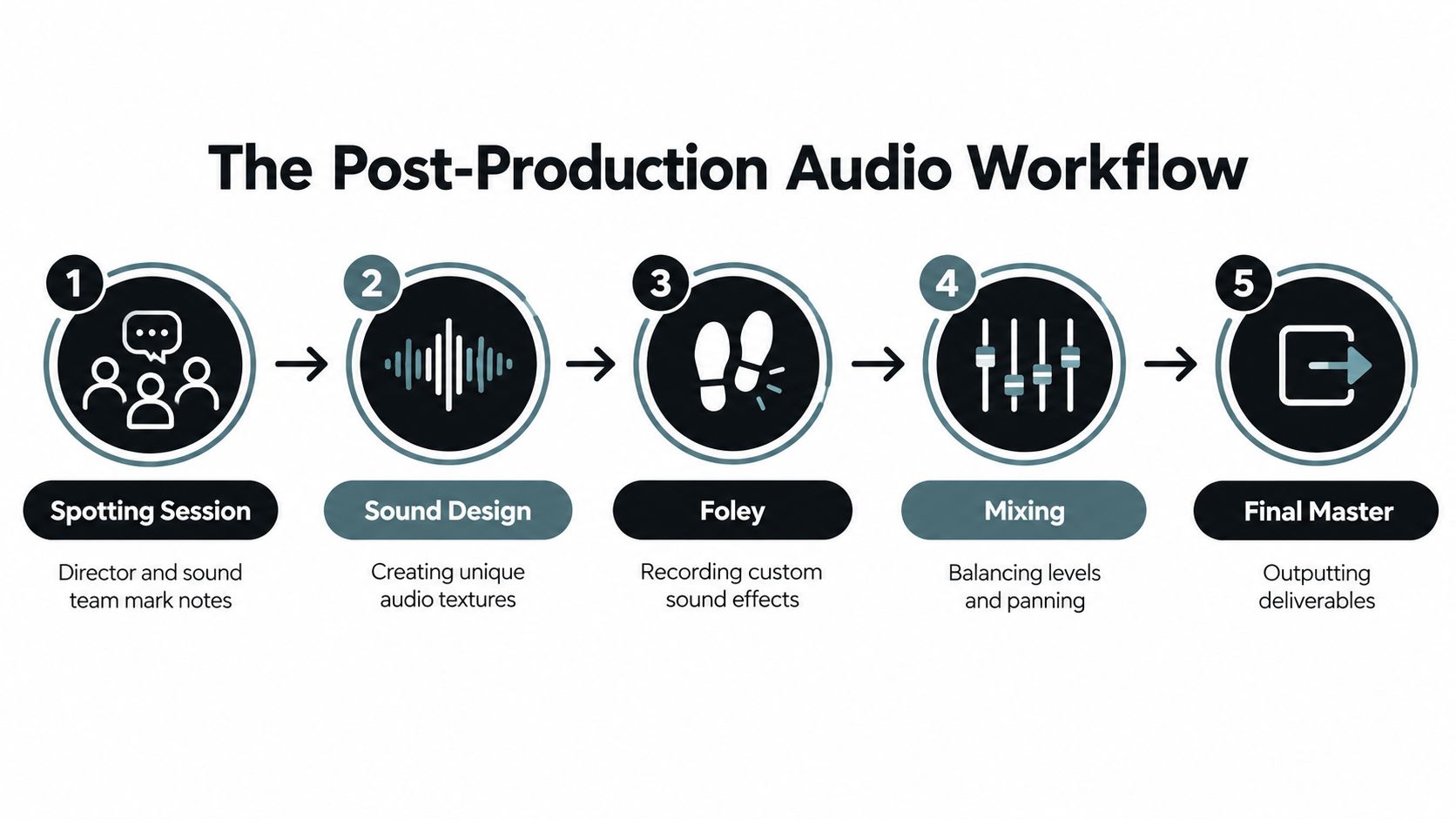
Postproduction works as a chain. Each decision changes what the next department can do, so a rushed handoff can create problems that appear much later in the mix.
Spotting defines the creative problem
The director, picture editor, supervising sound editor, and sometimes the composer watch the cut together. They mark lines that need ADR, actions that need Foley, transitions that need effects, moments where ambience should change, and places where silence might carry more weight than a sound.
Spotting prevents the team from treating every gap as a defect. A missing sound may be an opportunity for restraint. A visually simple action may need a complex design because it changes the audience's understanding of the scene.
Editing prepares the material for performance
Dialogue editors choose the strongest production takes, remove unwanted noise, shape breaths, smooth edits, and match room tone. If a line was damaged by a plane, wind, or a noisy take, the team records ADR. The actor performs the line while watching the image, and the editor matches timing, perspective, and acoustic character to the surrounding scene.
Foley artists then record footsteps, cloth, props, and contact sounds in sync with picture. The Foley pass doesn't replace every production detail. It supplies controlled, editable performances where the original track lacks clarity or physical emphasis.
SFX editors build designed elements and hard effects. A machine may begin with a production recording, then gain additional mechanical movement, electrical texture, resonance, and low-end weight. The editor chooses elements according to the scene's dramatic purpose, not just according to what the object sounds like in reality.
For filmmakers moving assets between formats, a practical audio extraction guide for video can clarify the difference between extracting a reference track and preparing material for editorial use. Extraction doesn't replace organized sessions, metadata, or properly conformed stems.
Premix and final mix solve different problems
The premix organizes dialogue, effects, Foley, and music into manageable stems. Each stem is balanced on its own before the rerecording mixer brings the groups together against picture. This stage exposes masking and tonal conflicts while there is still time to revise the underlying edits.
The final mix is where the rerecording mixer rides levels, pans sounds, shapes perspective, manages transitions, and decides what the audience should notice at each moment. The result may include a printmaster for playback, plus separate dialogue, effects, and music stems and an M&E version for distribution.
Software choices affect speed, but organization affects reliability. This guide to audio post-production software is relevant when comparing editing, restoration, mixing, and delivery tools, but no application can compensate for missing room tone or unclear editorial decisions.
Mixing Dialogue, Ambience, and Effects Together
A mix becomes readable when each layer has a job and enough space to perform it. The goal isn't to make dialogue loud while making everything else quiet. The goal is to control frequency, dynamics, and perspective so the audience hears the intended relationship.
Start with dialogue. A high-pass filter below roughly 80 to 100 Hz can remove rumble from handling, traffic, or air movement. If the voice sounds boxy, reducing 200 to 400 Hz can clear the congested middle. A presence lift around 2.5 to 5 kHz can improve consonant definition, while de-essing around 6 to 8 kHz can control sharp sibilance, as outlined in this film sound design mixing guide.
Use compression to reduce performance swings rather than erase them. A moderate compressor can keep a quiet line from disappearing and prevent a shout from dominating the scene. Listen in context. A voice that sounds polished alone may become thin or aggressive once music and effects enter.
Layer decisions should follow priority
Ambience often needs less low-frequency energy when it competes with speech. A low-shelf reduction can prevent the room bed from filling the same space as dialogue, while a restrained high-frequency lift may push the ambience farther behind the action. Hard effects can briefly take priority by ducking the ambience underneath them, then allowing the room to return naturally.
| Layer | Key EQ Move | Dynamics | Relative Level |
|---|---|---|---|
| Dialogue | Remove rumble, reduce boxiness, add presence carefully | Moderate compression and controlled sibilance | Foreground when it carries story |
| Ambience | Reduce muddy low end and preserve useful air | Gentle leveling or automation | Background, with purposeful rises |
| Effects | Shape frequency around the action and avoid masking speech | Transient control or brief ducking | Rises for narrative emphasis |
| Music | Carve space around important speech frequencies | Automation and stem compression as needed | Supports interpretation without covering lines |
Loudness targets depend on the delivery specification. One industry guide recommends aiming for about -12 dBFS peaks on the mix bus, then normalizing to -23 LUFS for broadcast or roughly -16 to -14 LUFS for streaming and YouTube, as described in the same film mixing reference. Treat those values as delivery requirements to verify with the distributor, not as a substitute for listening.
A true-peak limiter can protect the master from overs, but heavy limiting can flatten impacts and make music fatigue the audience. Before delivery, audition the mix on headphones, nearfield monitors, a television-style speaker, and a quiet playback system. The balance should survive changes in playback without losing words or dramatic contrast.
For a practical look at routing, gain staging, and layer relationships, use this audio mixing workflow alongside your own calibrated monitoring process.
Where AI Tools Like Isolate Audio Fit In
AI separation is most useful when it solves a specific editorial problem. It shouldn't become an excuse to skip clean recording, careful selection, or a human mix decision.
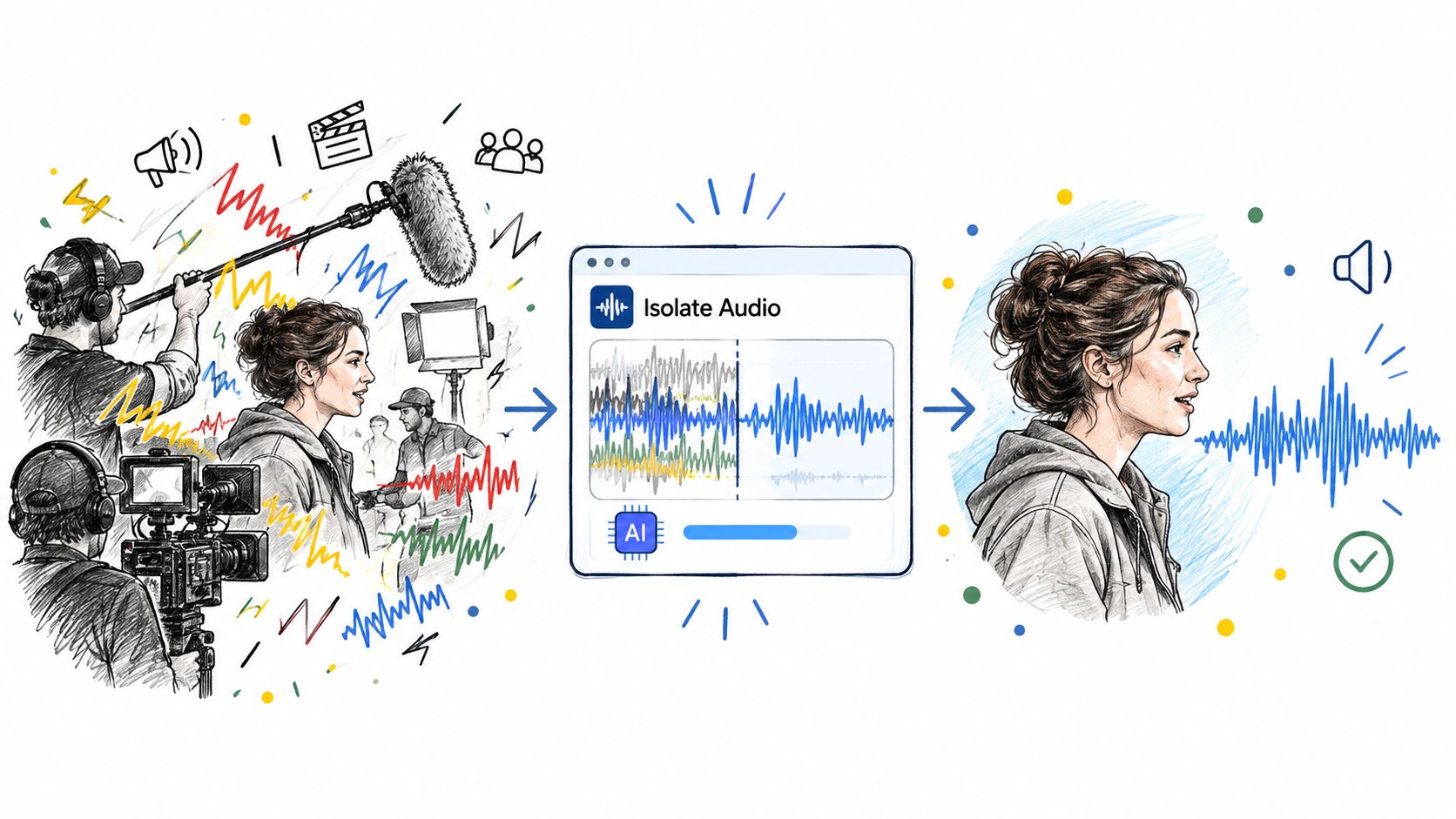
Suppose a location take contains a strong performance under traffic and reflected room noise. An AI isolation pass can separate a vocal-focused element for inspection and cleanup. That may help the editor decide whether the original take can be restored, whether a replacement line is needed, or whether the isolated material can support a subtle repair. Push the process too hard, though, and the voice may lose body, develop phase-like artifacts, or sound detached from the space.
Ambience extraction offers a different use. A busy scene may contain a useful room character beneath dialogue and music. Separating that environmental layer can provide a reference for rebuilding room tone on another angle. The result won't automatically match the perspective, but it may preserve the acoustic identity better than choosing an unrelated library bed.
Use separation for versions and investigation
A separation tool can also help prepare alternate material:
- Dialogue checks: Extract a speech-focused layer to identify masking, clipped consonants, or sections that need ADR.
- M&E preparation: Separate dialogue from a reference mix when the original session is incomplete, then treat the result as a repair source rather than a guaranteed final stem.
- Music and effects review: Isolate a musical or effects component to audition how the scene works without it.
- Foley reuse: Pull a recognizable footstep, impact, or texture from reference material for further editing and replacement recording.
Isolate Audio accepts audio or video uploads and lets users describe a target sound in plain English, such as dialogue, footsteps, or another effect. It returns an isolated element and the remainder, with quality presets and a Precision Mode for difficult overlaps. That makes it suitable for exploratory passes, cleanup decisions, and version preparation, provided a sound editor checks the results against the original.
AI also changes expectations for previsualization. Filmmakers exploring tools that generate video with audio should still separate concept testing from final production sound. Synthetic convenience can help a team communicate an idea, but believable location texture, performance nuance, and consistent deliverables still require editorial judgment.
The right role is fast pre-cleaner and source investigator. Keep the unprocessed original, compare the isolated result against it, audition phase and low-end behavior, and restore natural ambience around any repaired line. A mixer protects the film's sonic character by deciding what should remain imperfect.
Common Pitfalls and How to Avoid Them
The most expensive sound problems often begin before anyone opens a mixing session. A filmmaker who treats audio as a finishing fix may discover after picture lock that the edit has no room for ADR, the effects timing is wrong, and the music occupies every frequency needed for speech.
Start with a sound conversation during script and preproduction. Mark scenes that depend on off-screen information, silence, vocal texture, unusual spaces, or complex action. A sound designer can flag where the story needs wild tracks, controlled effects recording, or a different production approach.
The recurring failures are practical
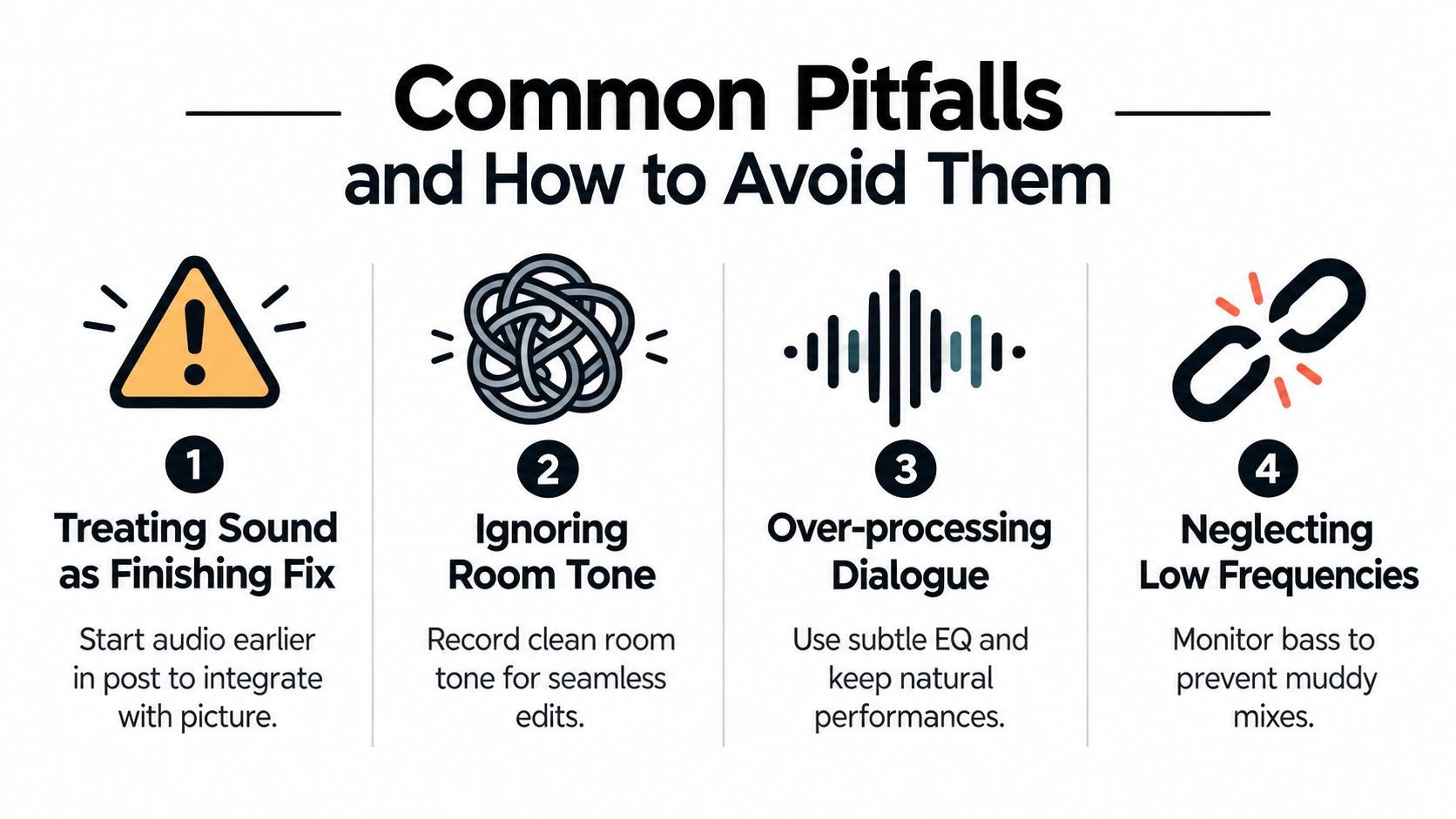
- Treating sound as a finishing fix: Late sound work forces editors to solve structural problems with hurried effects and emergency ADR. Schedule spotting early enough for sound to influence the cut.
- Ignoring recording hygiene: Poor lav placement, missing room tone, and undocumented disturbances make dialogue edits obvious. Capture clean wild lines and write useful sound reports while the location is still available.
- Over-processing dialogue: Aggressive noise reduction, EQ, or separation can remove breath, body, and room connection. Compare every repair with the original and use the least processing that solves the problem.
- Neglecting low frequencies: Unchecked rumble and overlapping bass make speech feel buried and effects feel uncontrolled. Monitor the low end deliberately, especially when adding vehicles, impacts, machinery, or music.
- Skipping deliverable planning: A distributor or festival may need a printmaster, stems, an M&E version, captions, or alternate loudness compliance. Build the delivery list at greenlight, not during the final export.
Dialogue clarity requires more than a loud fader. The mix should preserve intelligibility while maintaining performance, perspective, and natural dynamics. The post team should run dialogue-first checks before adding dense music and effects, then revisit the scene after every major design change.
AI separation deserves the same discipline. It can rescue a difficult source, expose a hidden layer, or accelerate an alternate version. It can't tell you whether an artifact has changed the character's identity, whether a room now sounds unnaturally empty, or whether a repaired line belongs emotionally with the take around it.
Better habit: Keep three references in every repair decision, the untouched source, the processed result, and the scene mix. If the processed version only sounds impressive in isolation, it probably isn't finished.
Create a repeatable review pass before delivery. Check dialogue in context, listen for ambience continuity across cuts, verify effects against picture, confirm stem alignment, and test the master on more than one playback system. Sound design becomes dependable when the team treats those checks as part of authorship rather than as technical cleanup.
Isolate Audio helps filmmakers separate dialogue, ambience, music, and effects from uploaded audio or video with plain-English prompts, making it useful for cleanup tests, source inspection, and alternate mix preparation. Visit Isolate Audio to test a difficult scene, compare an isolated element with the original, and decide where AI assistance can support your human sound-editing choices.